Where Can I Go by Train from Trieste?
Train destinations from Trieste, Italy: Venice and the Italian network, Ljubljana and Villach on international routes, plus coach day trips that fill the gaps.
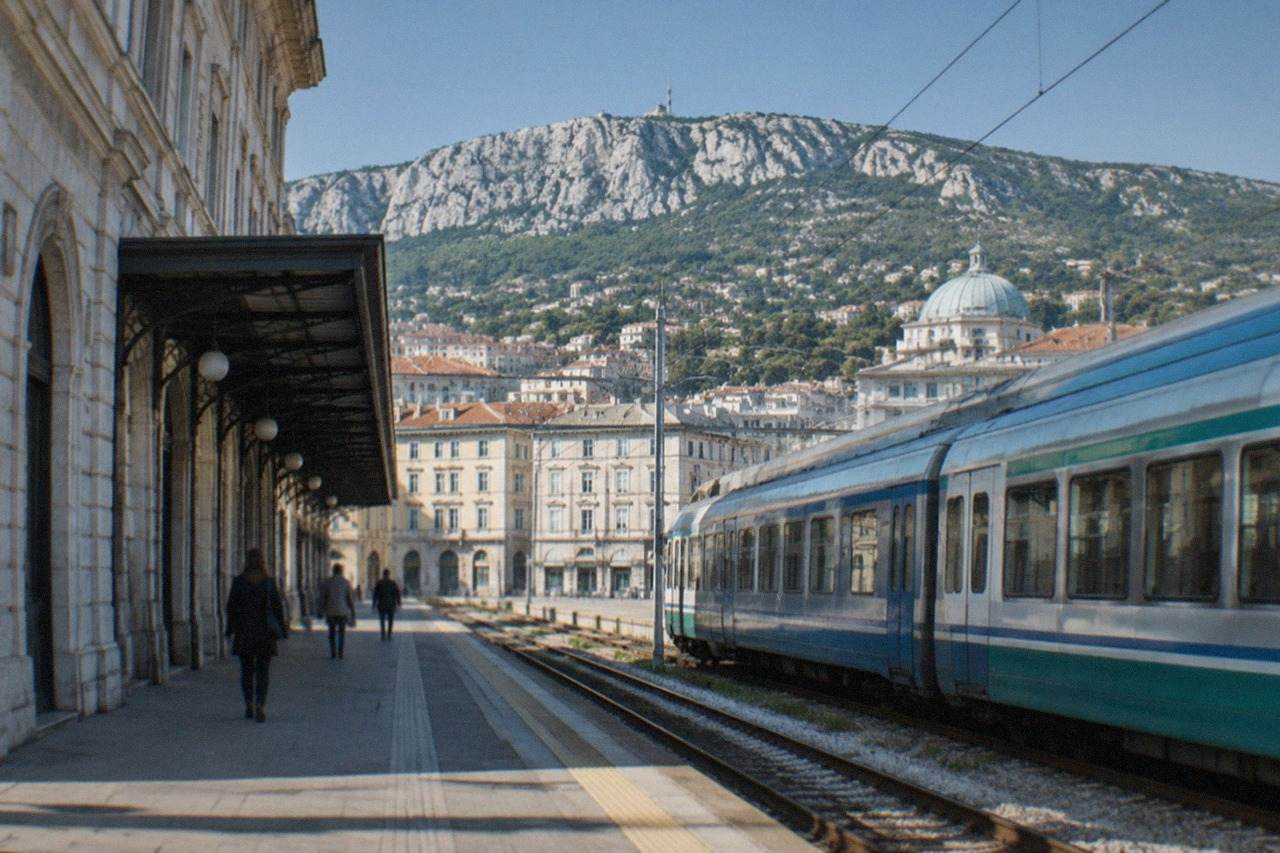
Trieste, the Adriatic port city in Friuli Venezia Giulia, northeast Italy, is a surprisingly useful place to arrive by train. The city's main station, Trieste Centrale, sits within sight of the water, the airport at Ronchi dei Legionari has its own railway station attached to the terminal, and the lines that meet here connect the Italian network with international routes towards Slovenia and Austria. The question "where can i go by train from trieste?" has a broader answer than most visitors expect, and this page lays out what the operators themselves publish, without invented journey times or fares.
Where Can I Go by Train from Trieste?
From Trieste you can travel by train along the Venice line down the Italian coast, ride regional, Intercity and Frecciarossa services on that corridor, cross into Slovenia towards Ljubljana and into Austria towards Villach on the international routes that serve the region, and use Trieste Airport's own station on your way in or out of the city. Not every destination is direct, and some borders need a passport, but the map is wider than most first-time visitors assume.
That is the honest top-level answer, and the detail matters. The airport's own service charter lists regional, Intercity and Frecciarossa trains among the services calling at Trieste Airport station, together with international trains to and from Villach and Ljubljana. What the charter does not do, and what no verified operator page in our pack does either, is publish a journey time or a fare for any specific trip from the city centre. So this page names destinations and service types, and leaves the minutes and euros to the ticket systems, which are the only places those numbers are real.
One practical note before the detail: the Venezia-Trieste line is the backbone of everything. Trenitalia's own travel-information pages reference works on that line, which is itself evidence of how much traffic it carries. If a schedule looks thin on the day you check, the operator's infomobilità pages are the live source, and this site deliberately does not bake a timetable into an article that will outlive it.
Which Italian Cities Can You Reach from Trieste by Train?
Venice is the anchor of Italian rail travel from Trieste: the Venice line carries regional trains along the coast and Intercity and Frecciarossa services on the same corridor, and from Trieste Airport station, joined to its terminal by a covered walkway of roughly 400 metres, the same three service categories run. Beyond Venice you connect into the wider Italian network, though the pack verifies the corridor, not every city you can reach with a change.
The Venice line deserves its own paragraph because it is the trip most visitors are actually planning. It runs along the northern Adriatic coast, and the rolling stock is a mix of stopping regional services and faster categories. For the specifics of the Venice run, including the high-speed question that comes up constantly, this site has two dedicated pages: a full guide to Trieste to Venice by train and a short answer on whether there is a high-speed train from Trieste to Venice.
The airport station is the quiet hero of Trieste rail travel. Trieste Airport, at Ronchi dei Legionari, is connected to its station by a covered pedestrian walkway of roughly 400 metres with moving walkways, so the transfer from plane to train is under cover end to end. Regional trains, Intercity trains and Frecciarossa high-speed trains all serve it, alongside international services to and from Villach and Ljubljana. Tickets come from trenitalia.com or the machines at the station and the terminal. For anyone landing in the region, the airport guide on this site covers the layout in detail, and the pages on whether there is a train to Trieste and on Trieste's train station and rail connections cover the inbound side.
Can You Take a Train from Trieste to Ljubljana or Villach?
Yes on both counts, with one caveat: international trains to and from Ljubljana and Villach are listed in the region's own service documentation, but the pack does not verify a daily schedule, a journey time or a fare from Trieste itself. Slovenia and Austria are both in the Schengen area, and all three countries around here, Italy, Slovenia and Austria, are reachable without changing currency if you carry euros.
The international connections are real but thinly documented in what we could verify. The airport's service charter names Villach and Ljubljana explicitly among international destinations, which is a strong signal of the corridor's role. For the lived schedule, the operator's own pages are the only source worth trusting, and this site keeps a dedicated answer on how long the train from Trieste to Ljubljana takes that states plainly what is and is not verified.
There is one border fact that trips up guide after guide, and it sits right on Trieste's doorstep. The European Commission's register of temporary border controls currently lists Italy as running checks on its land borders with Slovenia from 19 June 2026 to 18 December 2026. That is a temporary, dated measure, not a permanent feature of the border, but it means one concrete thing for a rail or road day trip from Trieste: carry a passport or a national ID card, even inside Schengen. Slovenia has no active controls listed with Croatia or Hungary.
The currency question is simpler than the border question. Croatia joined the Schengen area and adopted the euro on the same day, 1 January 2023, and Slovenia has been in both Schengen and the euro area for years. There is no money-changing errand anywhere on a day trip out of Trieste, whichever direction you pick.
Which Day Trips from Trieste Work Without a Car?
The strongest car-free day trips out of Trieste are the cross-border ones that coaches and small-group tours already run: Ljubljana and Lake Bled in Slovenia, Postojna Cave and Predjama Castle, the Piran coast, and the Lipica stud farm with the Škocjan Caves. Operators list these with round-trip transport and guiding included, with prices for each on the table below, which removes the train-plus-local-bus puzzle that Slovenia's smaller towns otherwise present.
The table below is the site's own tour data, not operator promises: each row is a verified product with its live-listing price band, its current rating and review count, and its duration. Slovenia's showpiece sights are its caves and its lakes, and they are scattered enough that a packaged day trip with transport is often the difference between doing them and reading about them.
| Day trip from Trieste | Service type | From (per person) | Rating | Reviews | Duration |
|---|---|---|---|---|---|
| Ljubljana and Lake Bled | Guided coach day trip | $108.91 | 4.69 | 544 | 9 hours |
| Postojna Cave and Predjama Castle | Guided coach day trip | $137.57 | 4.76 | 543 | 6 hours |
| Piran and the Slovenia coast | Guided coach day trip | $114.64 | 4.57 | 136 | 6 hours |
| Lipica stud farm and Škocjan Caves | Guided day trip | $129.93 | 4.86 | 23 | 6 hours |
Two of those deserve a word of context. The Postojna pairing is the single most-reviewed day trip on this site's roster, 543 reviews at the time of writing, because Postojna Cave is the best-known cave in the world and Predjama Castle is the only preserved cave castle in Europe. And the Piran trip matters to rail travellers specifically, because the Slovenian coast is the one corner of this region where a car-free plan genuinely gets fiddly. If a water crossing appeals instead, this site has a full guide to day trips from Trieste that covers the coastal routes in more depth.
A practical note on booking any of them: the cross-border coach operators, Flixbus and the regional TPL FVG services, also run to Ljubljana, Piran and Portorož, Rijeka and Pula, from Trieste's coach stations, but their frequencies and departure points were not verifiable in official sources at the time of writing, so check the operator's site for the current timetable rather than trusting a summary.
How Do You Get Around Trieste Once Your Train Arrives?
Once you are off the train, Trieste runs an ordinary urban network you can tap a bank card on: single tickets cost €1.50 for 60 minutes and €1.85 for 75 minutes, a day ticket is €3.35, and the Opicina tram, reactivated on 1 February 2025, runs from piazza Dalmazia as urban line 2 under the same fares. On-board "Eva" readers accept contactless cards and digital wallets and apply the cheapest applicable fare.
The tram is the detail worth knowing, because almost every older guide gets it wrong. The tram de Opicina was suspended after an August 2016 collision and came back on 1 February 2025. Its city terminus is piazza Dalmazia, not piazza Oberdan as decades of guidebooks say, and Trieste Trasporti's line-2 page carries a current timetable dated 20 July 2026, which is the live source for its running status. A standard urban ticket covers it, and you can tap on board. The full fare list as published by the operator:
| Code | Ticket | 2026 price | Validity |
|---|---|---|---|
| U01 | Urban single | €1.50 | 60 minutes |
| U02 | Urban single | €1.85 | 75 minutes |
| U24 | Day ticket | €3.35 | Whole service day |
| U10 | 10 rides | €13.50 | Carnet |
| U20 | 20 rides | €16.65 | Carnet |
Single tickets are valid for 60 or 75 minutes, extended to 240 minutes on Sundays and public holidays, so a day of hopping between the waterfront, the Città Vecchia and the castles can run on one or two taps of a card. Season-pass prices sit in the same operator PDF but did not extract cleanly, so this page does not print one.
If you would rather be shown the city than navigate it, the orientation options are covered on this site. The cheapest of them is a free, tip-based GuruWalk walk with a local guru, listed on this site's guide to free walking tours in Trieste. For a guided walk with the coffee ritual folded in, the operator's live listing is the place to check dates and languages, and more orientation ideas live on the Trieste Travel Guide homepage.
What Should You Check Before Booking Train Travel from Trieste?
Check three things before you commit: the live timetable on the operator's own pages, because works and suspensions are announced there first; your passport or ID card, because Italy is running temporary checks on the Slovenia land border until 18 December 2026; and the seasonal opening hours of whatever you are travelling to, because several of the region's headline sights keep winter schedules that differ sharply from summer ones.
The timetable point is not boilerplate. Trenitalia's travel-information pages currently reference regional maintenance on the Venezia-Trieste line, and Trieste Trasporti's homepage carries live notices about the urban network. Neither of those facts belongs in an article as a permanent statement, which is exactly why this page links none of them as fixed schedules.
The passport point matters more on this border than on most. Schengen normally means no routine check, but the Commission's register currently lists Italy's temporary controls on the Slovenia land border as running to 18 December 2026, and a day tripper without ID can end a trip at a platform instead of a lake.
The seasonal point is where rail travellers lose the most time. The operator day trips above run to fixed daily patterns in high season and thin out in winter, and several venues keep sharply seasonal hours: Grotta Gigante, for one, is guided-only with compulsory booking, and it runs Tuesday to Sunday from September to February, daily from March to August. A winter rail arrival with a summer's assumption about opening hours is the classic way to waste a day in this region.
Common Questions About Train Travel from Trieste
Where can i go by train from trieste?
From Trieste, Italy you can ride the Venice line down the Italian coast on regional, Intercity and Frecciarossa services, reach Ljubljana and Villach on the international routes documented in the region's service charter, and use Trieste Airport's own station on the way in or out. Cross-border coach services fill the gaps towards Slovenia's coast and Croatia.
Does Trieste have a train station?
Yes. Trieste Centrale is the city's main station, and Trieste Airport at Ronchi dei Legionari has its own station attached to the terminal by a covered walkway of roughly 400 metres. The airport's service charter lists regional, Intercity, Frecciarossa and international trains calling there.
Is there a high-speed train from Trieste to Venice?
Frecciarossa high-speed services are listed among the trains serving the region's corridor, alongside regional and Intercity trains. For the specific departure that matches your day, check the operator's live booking system, which is the only source with the real schedule.
Can you take a train from Trieste to Croatia?
Not on any route this site could verify from official sources. The practical car-free route to Rijeka or Pula is the cross-border coach network, and Croatia is straightforward once you are there: it joined Schengen and adopted the euro on the same day, 1 January 2023, so there is no border formality of the old kind and no currency change.
How long is the train from Trieste to Ljubljana?
No journey time for that route could be verified on an official operator page, so this site does not print one. International trains to and from Ljubljana are documented in the region's service charter, and the operator's booking system holds the current times.
Where is the Flixbus stop in Trieste?
Long-distance coaches depart from Trieste's coach stations in the city, but the exact stop and the current departures to Ljubljana, Piran, Portorož, Rijeka and Pula were not verifiable in official sources at the time of writing. The operator's own site is the reliable source for the stop and the timetable.
The short version: base yourself in Trieste, use the Venice line and the international routes for the long legs, let the operator day trips handle Slovenia's scattered showpieces, and carry ID for the Slovenian border until the current checks lapse in December 2026. That combination covers almost everything in this corner of Italy and the two countries beside it, without a hire car and without an invented timetable anywhere on the page.