Trieste Train Station and Rail Connections: Italy's Adriatic Rail Hub Explained
Trieste Centrale is the rail gateway to Trieste, Italy, the Adriatic port city in Friuli Venezia Giulia, and this guide covers its tickets, connections, the Opicina tram and the cross-border routes to Slovenia and Croatia.
Short answer
Trieste Centrale is the city's main station, a short walk from Piazza Unità d'Italia, with direct trains toward Venice, the airport and international services toward Slovenia and Austria. An urban single costs €1.50 for 60 minutes, a day ticket €3.35, and the Opicina tram runs from piazza Dalmazia as ordinary urban line 2.
Trieste Centrale is the main railway station of Trieste, Italy, the Adriatic port city in Friuli Venezia Giulia that sits closer to Ljubljana and Zagreb than to Milan. The station is the terminus of the Venetian plain rail corridor and the point where Italian domestic services meet a small set of international connections toward Slovenia and Austria, which makes it unusually cosmopolitan for a city of its size. This guide, part of the wider coverage on Trieste Travel Guide, covers what the station is, what it costs to travel from it, which cities you can reach by rail, and how the Opicina tram and the urban bus network fit around it. If you only want the short version, the answer page does Trieste have a train station covers the basics.
Where Is Trieste Centrale Station and What Is It Called?
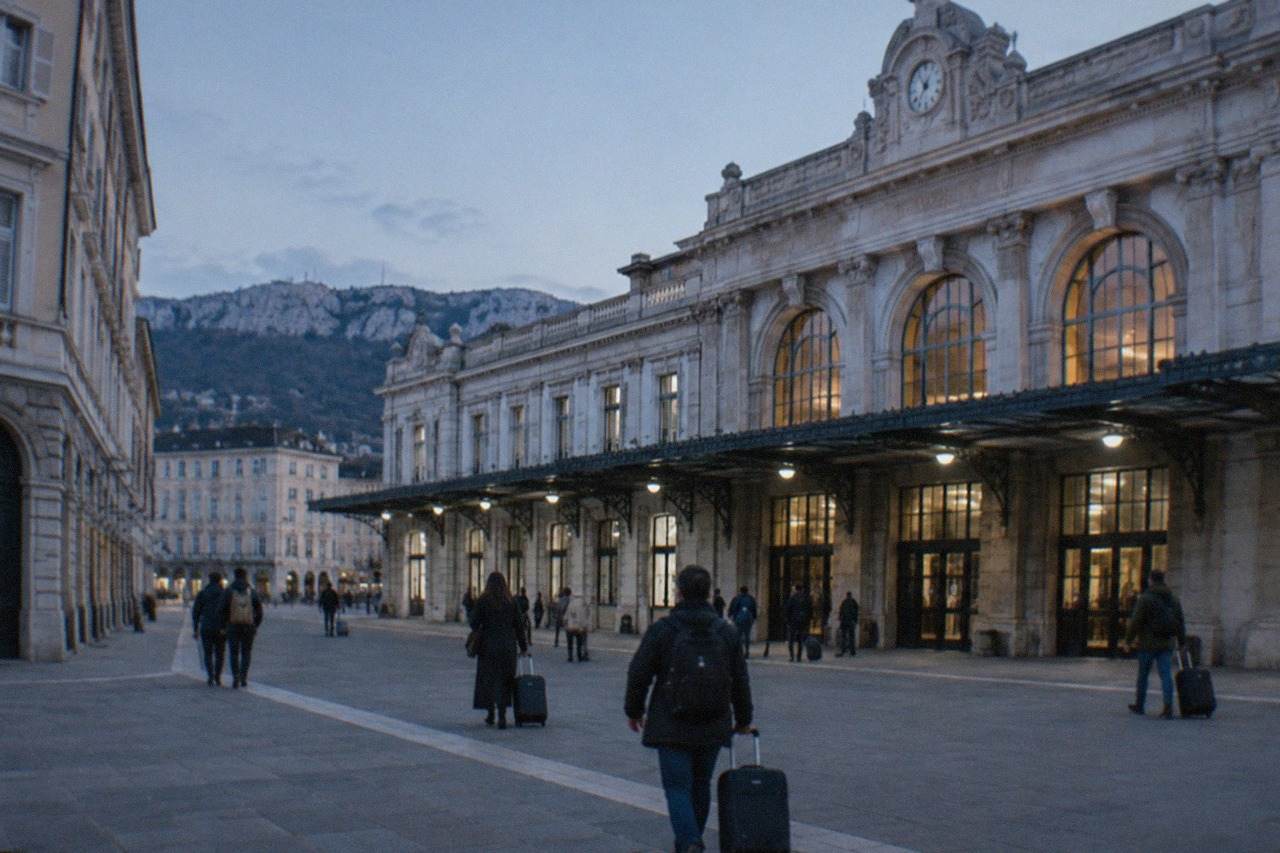
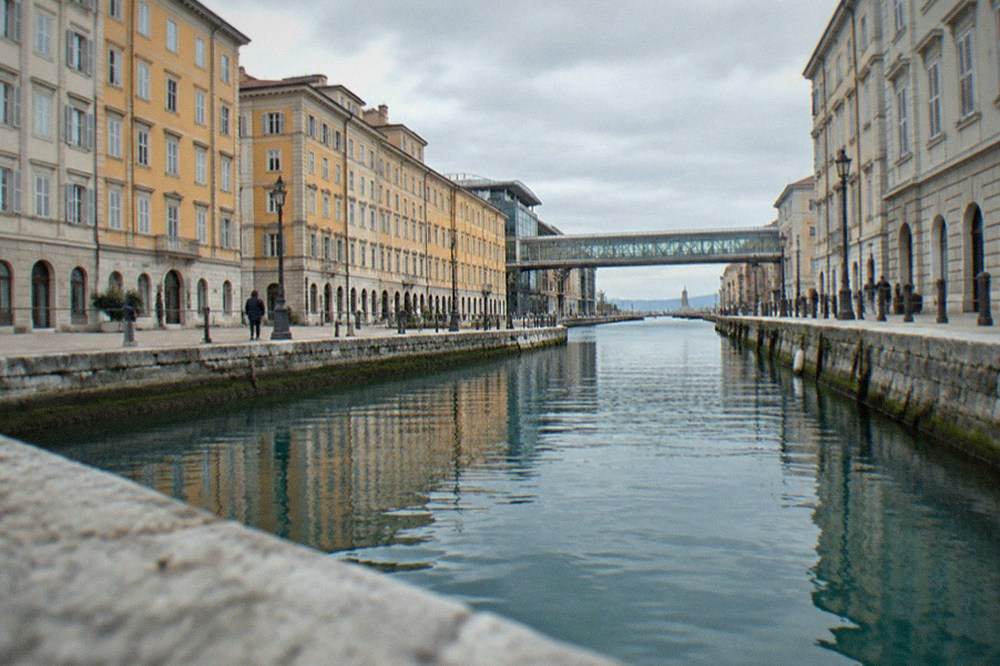
Trieste's main station is Trieste Centrale, and it is the only through-hub the city needs: it sits at the northern edge of the Borgo Teresiano grid, a level, walkable stretch of the city centre, close to the seafront and the Grand Canal, with the urban bus network and the Opicina tram connection integrated around it. The station is the Italian rail system's last stop on the Adriatic north-east corner, and almost everything a visitor needs is within the ordinary urban ticket described below.
The name matters more here than it would in most Italian cities, because Trieste collides in search results with a bathyscaphe, a San Francisco café chain and a basketball club, so a booking site or timetable app that only says "Trieste" is worth a second look. The station appears in Trenitalia's systems as Trieste Centrale, which distinguishes it from Trieste Airport, the station beside the terminal at Ronchi dei Legionari, and from the historic name Trieste Campo Marzio, associated with the old cross-border and imperial-era network. When you buy a ticket, the destination you want is Trieste Centrale.
The station building itself is a piece of Habsburg-era civic architecture, which fits a city that was the Empire's main sea outlet, and its position on the flat grid of the Borgo Teresiano means the walk out of the front door is straight and level. The surrounding district is the elegant, café-dense part of the city described in our Trieste coffee culture guide, and the seafront Rive are a short walk away. Cruise passengers arriving at the nearby terminal face the same question in reverse, and our page on walking from the cruise port to the train station answers it directly.
Which Cities Can You Reach by Train from Trieste?
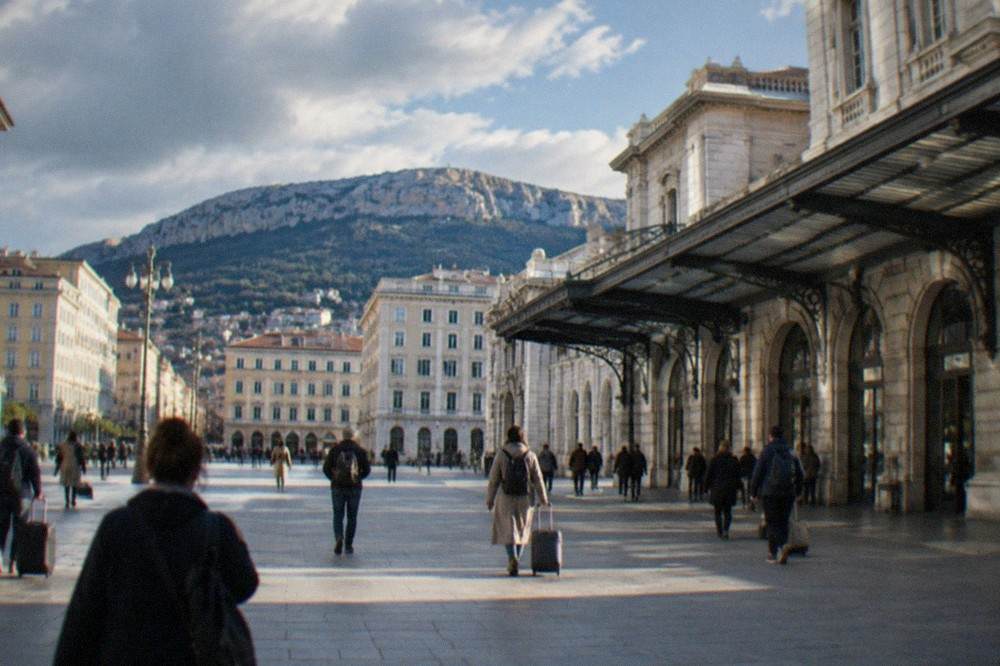
From Trieste Centrale you can travel by rail to Venice and the Venetian plain, to Trieste Airport at Ronchi dei Legionari, and onward on the same corridor toward Udine and the rest of Friuli Venezia Giulia, plus a small set of international services that the airport's own service charter lists as including connections toward Villach and Ljubljana. The station is a terminus, so trains leave in one main direction, north-west along the coast, and every domestic journey starts on that single corridor.
The domestic spine is the line toward Venice. High-speed Frecciarossa services, Intercity trains and regional trains all use it, and the practical questions visitors ask are answered on our dedicated pages: whether there is a high-speed service, is there a high-speed train from Trieste to Venice, and the full route breakdown on Trieste to Venice by train. The same corridor serves Trieste Airport station, covered in detail in our Trieste Airport guide, and the regional network beyond it toward Udine, Aquileia country and the Tagliamento.
The international picture is thinner than the map suggests, and it is better to be honest about it. The airport's own service charter lists regional, intercity, high-speed and some international trains, giving Villach and Ljubljana as examples, but the pack gives no timetable or frequency for any cross-border rail route, so this guide will not invent one. For Ljubljana specifically, our page how long is the train from Trieste to Ljubljana covers what is known, and the practical reality is that many travellers cross to Slovenia by coach instead. Croatia is a similar story: see is there a train from Trieste to Croatia, and treat the ferry option described in our Trieste cruise port guide as a genuine alternative for the Istrian coast.
| Route from Trieste Centrale | Service types listed in the pack | Where this guide covers it |
|---|---|---|
| Trieste to Venice | High-speed, Intercity and regional services on the Venetian plain corridor | The Venice-by-train section above |
| Trieste to Trieste Airport (Ronchi dei Legionari) | Regional, Intercity and high-speed trains serve the airport's own station | The airport section below |
| Trieste toward Villach and Ljubljana | Some international services, examples given in the airport's service charter | The cross-border section below |
| Trieste to Croatia by rail | No timetable or frequency verified in the pack | The cross-border section below |
If you are planning around the train rather than through it, the question of how to get from Venice to Trieste by train is the most common arrival route, and whether the journey is scenic is worth reading before you book a seat side. For a wider sweep of rail destinations, the day-trip pages on this site list the realistic radius, including the cross-border options in our day trips from Trieste guide.
How Much Do Tickets Cost at Trieste Train Station?
A Trieste urban single costs €1.50 for 60 minutes of validity or €1.85 for 75 minutes, a day ticket is €3.35, a 10-ride carnet is €13.50 and a 20-ride carnet €16.65, all from Trieste Trasporti's own 2026 urban tariff sheet dated 29 December 2025. Singles stretch to 240 minutes on Sundays and public holidays, and contactless bank cards and digital wallets can be tapped on board, with the system applying the cheapest applicable fare automatically.
Those figures come from the operator's published 2026 tariff PDF for the urban network, and they are the numbers to plan around for anything inside the city: buses, and the Opicina tram, which is ordinary urban line 2. The tariff sheet also lists season passes, but the pack flags that those prices did not extract unambiguously, so this guide does not print one; check the operator's tariffs page before committing to a pass. The contactless detail is the one genuinely modern convenience: you tap a Mastercard, Visa or American Express, or a wallet, on the "Eva" readers on board, and you do not need to find a ticket machine first.
| Code | Ticket | 2026 price | Validity |
|---|---|---|---|
| U01 | Urban single | €1.50 | 60 minutes |
| U02 | Urban single | €1.85 | 75 minutes |
| U24 | Urban day ticket | €3.35 | One day |
| U10 | 10 rides | €13.50 | Ten urban journeys |
| U20 | 20 rides | €16.65 | Twenty urban journeys |
Rail tickets are a separate system entirely, bought through Trenitalia's own channels, machines at the station or the operator's site, and the pack verifies no specific rail fare, so this guide prints none. What the pack does verify is where the two systems meet: the airport station beside the terminal, and the urban network that carries you the last mile into the Borgo Teresiano. One thing worth knowing before you arrive is the city's tourist tax, because almost every visitor arriving by train ends up paying it that evening.
| Tourist tax rate (per person, per night) | Accommodation category |
|---|---|
| €3.80 | 5-star hotel / residenze turistico-alberghiere |
| €3.30 | 4-star hotel, RTA or self-catering "case vacanza" |
| €3.00 | 3-star hotel, RTA or "case vacanza" |
| €2.30 | 2-star hotel, B&B Superior, hostels, agriturismi and short-let properties |
| €2.00 | B&B Comfort |
| €1.80 | 1-star hotel or B&B Standard |
| €1.50 | Campsites and equipped motorhome areas |
The tax is charged for a maximum of five consecutive nights in the same property, and everyone under 18 is exempt, along with several other categories listed in the Comune's own 2026 table. It is a small line on the bill, but it surprises travellers who assumed a mid-range Italian city would be cheaper on arrival, a question this site's cost-of-a-trip coverage unpacks in full.
How Do You Get from Trieste Airport to Trieste Centrale?
Trieste Airport at Ronchi dei Legionari has its own railway station, joined to the terminal by a covered pedestrian walkway of roughly 400 metres with moving walkways, served by regional, Intercity and high-speed trains, so the transfer is a short train ride rather than a bus or a taxi. The airport's own service charter confirms the walkway and the train types, and the bus alternative departs from the intermodal hub beside the terminal.
The covered walkway is the detail that makes this airport unusually easy: you land, you walk indoors on moving walkways, and you are on a platform. The station is on the same Venetian plain corridor as Trieste Centrale, which means the airport is also a rail stop on journeys to and from Venice, so a traveller flying in and continuing by train can change at the airport station itself. Our flights to Trieste guide covers which airlines serve the airport, and the airport section of this site's transport coverage handles the terminal, the station and the bus hub in detail.
Because no fare or journey time is verified in the pack, the honest planning advice is to check the operator's own pages before you travel. What can be stated is the structure: regional trains, Intercity trains and Frecciarossa high-speed services all call at the airport station, and TPL FVG bus lines plus long-distance coaches run from the intermodal hub a short walk from the terminal. Trenitalia's own infomobility pages carry live engineering notices for the Venetian plain corridor, and the pack notes regional maintenance with some bus replacements there through October, so a same-week check is worth the two minutes.
Does the Opicina Tram Still Run from Trieste?
Yes, the Opicina tram is running: it was reactivated on 1 February 2025 after the long stop that followed the August 2016 collision, it operates today as ordinary urban line 2, and its city terminus is piazza Dalmazia, not piazza Oberdan, with the route running about 5.175 km to Opicina via Vetta Scorcola, Conconello and the Obelisco. Trieste Trasporti's own line-2 page carries a current timetable dated from 20 July 2026, and a standard urban ticket or a contactless tap on board is valid.
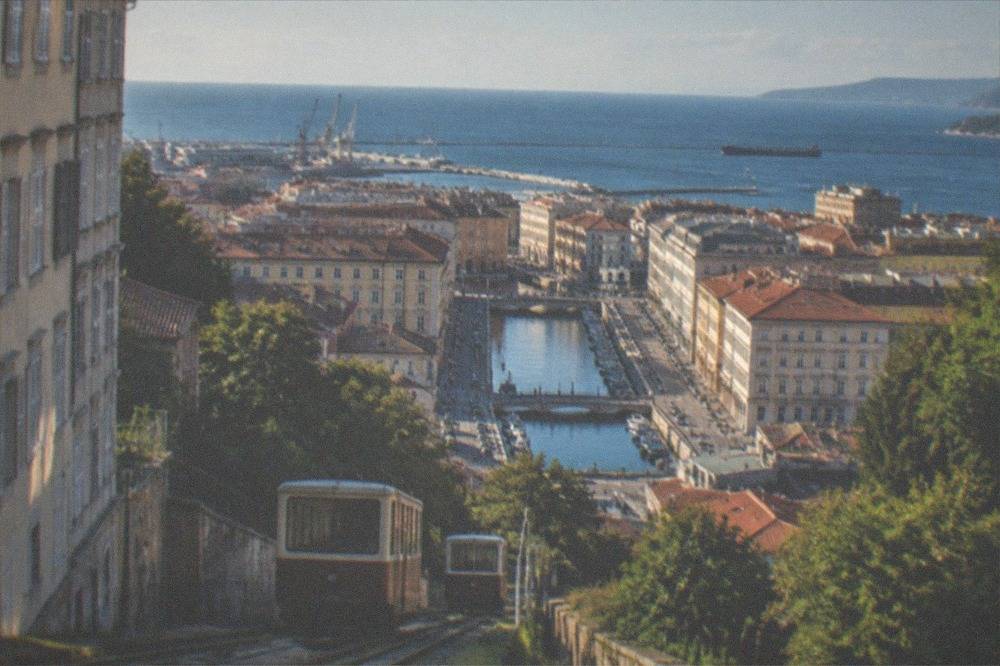
Almost every older guide gets this wrong, in both directions: some say the tram is dead, others send you to Piazza Oberdan, which the operator's own route description no longer lists as the terminus. The published route is piazza Dalmazia to piazza Casali, Sant'Anastasio, via Romagna, Vetta Scorcola, Cologna, Conconello, the Obelisco and Opicina station. It is a funicular-tram hybrid that climbs the escarpment of the Carso plateau, and the views from the upper section over the Gulf of Trieste are the reason it survives as a working line at all. Our Opicina tram and Obelisk guide covers the ride and the village at the top.
| Opicina tram, line 2 | Detail from the operator's own pages |
|---|---|
| Status | Running, reactivated 1 February 2025 |
| City terminus | piazza Dalmazia |
| Mountain terminus | Opicina (stazione trenovia) |
| Route length | About 5.175 km |
| Timetable | Current line-2 timetable dated from 20 July 2026 |
| Ticketing | Ordinary Trieste urban ticket, or contactless tap on board |
One caution: the pack records a short maintenance suspension in mid-September 2026 with a replacement bus, which is exactly the kind of transient notice that should never be baked into a travel guide. The durable advice is to check the operator's line-2 page on the day you travel, because a working heritage line does stop for maintenance occasionally, and the replacement bus is part of the ordinary urban network when it does. The tram is also, functionally, a commuter line: it carries residents up and down the escarpment all day, and it is included in the same €1.50 single and €3.35 day ticket as every city bus.
If the plateau at the top of the tram is where your interest in the Carso begins, the cave country starts there. The covers the giant cave at Sgonico with a guided descent and museum entry, and the venue's own pages set the terms: guided tours only, booking compulsory, adult €15, children 6-18 €8, departures at 9:00, 10:00, 11:00, 12:00, 14:00, 15:00 and 16:00, closed on Mondays from September to February and daily from March to August.
Do You Need a Passport for a Day Trip to Slovenia or Croatia from Trieste?
Carry a passport or national ID card for any day trip from Trieste into Slovenia, because Italy is running temporary internal border checks on its land border with Slovenia from 19 June 2026 to 18 December 2026, per the European Commission's own register. Slovenia and Croatia are both in the euro and both in Schengen, Croatia having joined both on 1 January 2023, so there is no currency change on the three-country circuit, only the temporary checks on this one land border.
This is the fact that most general guides to the region get wrong, in both directions. Some tell you Slovenia needs no ID at all, which is bad advice while the temporary checks are in force; others imply a hard border with passport control, which is also wrong, because the checks are temporary, dated and targeted at the land crossing. The correct framing is the Commission's own: Italy has notified temporary internal border controls on the land borders with Slovenia running to 18 December 2026, and Slovenia has no active controls listed with Croatia or Hungary. Check the register before you travel, because these notifications change.
The currency question deserves its own sentence because it gets mangled constantly: Italy, Slovenia and Croatia all use the euro. Croatia adopted it and joined Schengen on the same day, 1 January 2023, so nobody crossing from Trieste to Piran, Ljubljana or Rovinj needs to change money. The destination options are laid out in the day trips from Trieste coverage on this site, including the cross-border routes by coach and ferry.
What Is the Weather Like Around Trieste Station?
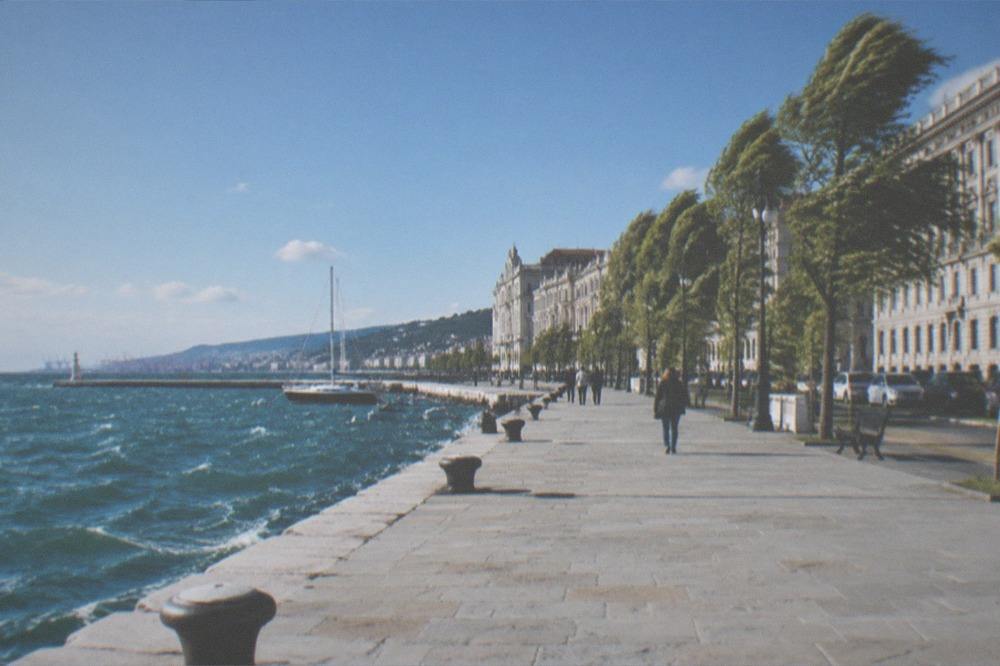
Trieste's climate, measured at ARPA FVG's own waterfront station on the molo Fratelli Bandiera over 1995-2024, averages 15.9 C across the year with 867.1 mm of rain over 86.1 wet days, and the rain is an autumn phenomenon: November is the wettest month at 109.8 mm, September second at 102.3 mm, and July the second driest at 53.8 mm. The bora's all-time measured peak is 168.1 km/h, in February 2012.
Those numbers overturn two stereotypes at once. The first is the "rainy northern Adriatic" idea, which is backwards: summer is comparatively dry here, and the wet season is September through November. The second is the idea that the bora is a winter-only event, which the station tables contradict: the monthly record gust exceeds 110 km/h in every single month of the year, and July averages more days with a gust over 90 km/h than April, May or June. June is the calmest month, at 0.3 days over 90 km/h on average.
| Month | Mean high C | Rain mm | Wet days | Days gust over 90 km/h | Sea C |
|---|---|---|---|---|---|
| January | 9.2 | 52.8 | 6.6 | 2.4 | 11.6 |
| April | 16.8 | 60.7 | 8.0 | 0.7 | 14.0 |
| July | 28.2 | 53.8 | 5.4 | 0.9 | 25.9 |
| September | 23.9 | 102.3 | 7.4 | 1.1 | 23.9 |
| November | 14.7 | 109.8 | 9.5 | 1.9 | 16.8 |
For rail travellers the practical read is simple: the weather rarely stops the trains, but it can stop the sailing. The Barcolana regatta, whose 58th edition runs 2-11 October 2026 with the main race on Sunday 11 October, sits inside the windy shoulder of the year on purpose, and October averages 1.4 days with a gust over 90 km/h. No published wind threshold exists at which ferries stop or events are cancelled, so do not believe any figure you see quoted: conditions are judged live by the authorities. Our Trieste weather month by month and best time to visit Trieste guides carry the full monthly picture.
Where Should You Stay Near Trieste Centrale?
The sensible base for a rail-first visit is the Borgo Teresiano, the grid district immediately around the station, which puts you a level walk from Piazza Unità d'Italia, the Grand Canal and the Rive, or the Città Vecchia on the hill behind the harbour for atmosphere at the cost of stairs. Everything inside the urban network is covered by the €3.35 day ticket, and the station district itself is flat, walkable and close to the caffè culture the city is known for.
The trade-off is predictable. Around the station you get the Habsburg grid, the historic cafés described in our Trieste coffee culture guide, and the shortest possible walk with luggage. The Città Vecchia, the old town below San Giusto, is more atmospheric and less convenient for a heavy suitcase, and the Barcola seafront is where the swimming and the sunsets are, at the cost of a bus ride into the centre. The full district-by-district breakdown, including the areas best avoided for a first visit, is on our where to stay in Trieste page, and the food map is separate: what to eat in Trieste and the best restaurants in Trieste cover the jota, the buffets and the osmize country on the plateau.
For travellers whose time in the city is a stopover between trains, the arithmetic changes. A few hours is enough for the station district's cafés and the seafront, and a turns a layover into a structured look at the landmarks with a local guide, from the listing's own description covering the modern and ancient charms of the city. The covers the same ground seated, with audio commentary, for visitors who would rather not walk at all.
Common Questions About Trieste Train Station
Does Trieste have a train station?
Yes. Trieste Centrale is the city's main station, a terminus on the Venetian plain corridor with regional, Intercity and high-speed services, and it sits at the northern edge of the city centre, close to the seafront.
Is there a high-speed train from Trieste to Venice?
Yes, Frecciarossa high-speed services run on the Trieste-Venice corridor, alongside Intercity and regional trains. The dedicated pages on the Venice route cover the details, and tickets are sold through the operator's own channels.
Can you walk from the Trieste cruise port to the train station?
The cruise terminal and Trieste Centrale are both on the flat northern side of the harbour area, and the walk is level along the city grid. The cruise-port coverage on this site includes the route and the alternatives.
Does the Opicina tram still run?
Yes. It was reactivated on 1 February 2025 and runs as urban line 2 from piazza Dalmazia to Opicina, on a timetable dated from 20 July 2026. Check the operator's line-2 page for live status on the day you travel.
Do I need a passport to go to Slovenia from Trieste?
Carry a passport or national ID card. Italy is running temporary border checks on the land border with Slovenia through 18 December 2026, even though both countries are in Schengen and both use the euro.
How much is a bus or tram ticket in Trieste?
A 60-minute urban single costs €1.50 and a 75-minute single €1.85, with a day ticket at €3.35, per Trieste Trasporti's 2026 tariff sheet. Contactless cards can be tapped on board and the cheapest applicable fare is applied.
Trieste Centrale is a small station with an oversized reach: one corridor carries you to Venice and the airport, one funicular-tram climbs the Carso, and one border notification, dated and temporary, is the only paperwork standing between you and Ljubljana. Plan around the €3.35 day ticket, carry ID for Slovenia, and check the operator's live pages the week you travel, and the rail side of Trieste, Italy will take care of itself.