The Opicina Tram and Obelisk in Trieste, Italy: How to Ride Line 2 Up the Karst
Trieste's tram de Opicina, urban line 2, is a century-old hybrid tram and funicular that climbs from the city floor to the Karst plateau, and it is running again. Here is the current route, the fares, and what waits at the top, including the Obelisk viewpoint.
Short answer
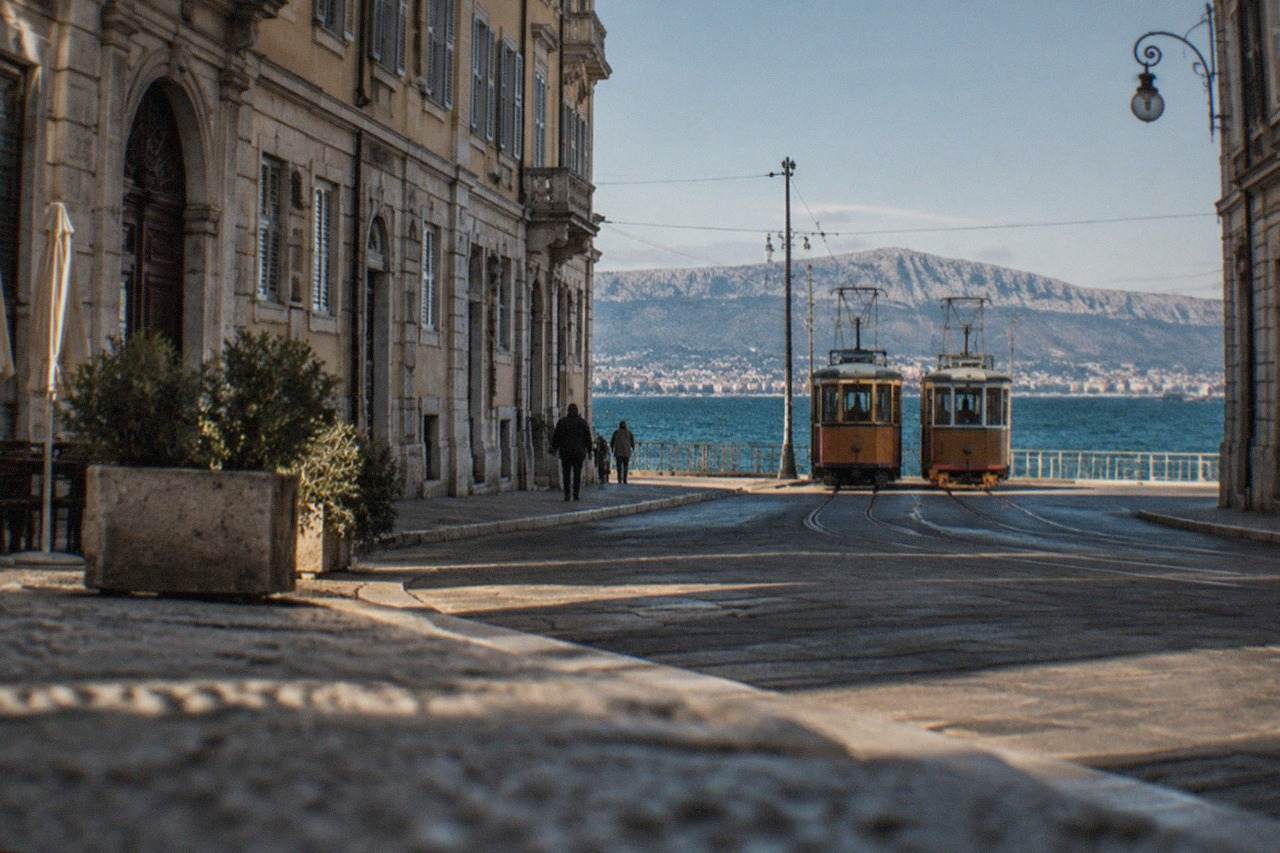
The Opicina tram is running: it was reactivated on 1 February 2025 and carries a current timetable dated 20 July 2026. Its city terminus is piazza Dalmazia, not piazza Oberdan, and a standard Trieste urban ticket is valid. The line runs about 5.175 km up the escarpment to Opicina, passing the Obelisk stop near the top.
Trieste, the Adriatic port city in Friuli Venezia Giulia in northeast Italy, is one of very few places in the world where you can ride a tram that turns into a cable-hauled funicular halfway up a cliff. The tram de Opicina, signed as urban line 2 in the Trieste Trasporti network, links the city floor to the Karst plateau above, and it has been doing so since long before most of the city's buses existed. It is also the attraction that competing guides most reliably get wrong, because the line spent years out of service after a 2016 collision and much of what you will read online still describes it as closed. It is not closed. Trieste Trasporti's own line-2 page carries a current timetable dated 20 July 2026, published 11 September 2026, and the tram runs today.
Is the Opicina Tram Running in 2026?
Yes, the Opicina tram is running in 2026. The line was reactivated on 1 February 2025 after the long stop that followed the August 2016 collision, and Trieste Trasporti's line-2 page currently carries a timetable headed "piazza Dalmazia to Opicina, from 20 July 2026", published 11 September 2026. Any guide telling you the tram is suspended, bus-replaced or awaiting reopening is describing the situation as it was years ago, not as it is now.
The operator TPL FVG states it plainly on its own service page: the line was "reactivated on February 1, 2025 (after a long stop following an accident that occurred in August 2016)". That is the single most important fact on this page, because the closure was so long that it fossilised into guidebook copy, and a visitor who plans around stale advice will simply miss the ride.
One practical caveat belongs here rather than buried further down. Like any working tram line, line 2 occasionally has short maintenance stops, and the operator publishes those on its own site as they happen. Do not bake any specific closure date into your plan from a third-party page, including this one: check the live status on the operator's line-2 page the day you ride. The permanent fact is that the line is in ordinary service; the transient details change and are the operator's to announce.
The tram is not a heritage toy priced like a museum ride, either. It is line 2 of the ordinary urban network, which means the same ticket you tap for a bus in the centre is valid on the tram, and you can pay by contactless bank card on board. That makes it one of the cheapest genuinely historic rail experiences in Italy.
Where Does the Opicina Tram Leave from in Trieste?
The Opicina tram's city terminus is piazza Dalmazia, a square in the north of central Trieste, and not piazza Oberdan, which older guides still name. The published route runs piazza Dalmazia, piazza Casali, Sant'Anastasio, via Romagna, Vetta Scorcola, Cologna, Conconello, Obelisco, and finally Opicina station, a run of about 5.175 km. The piazza Casali stop is currently inactive on the published route.
The Oberdan confusion is worth a paragraph of its own, because it sends people to the wrong square. Piazza Oberdan was the historic terminus, but the line's published terminus today is piazza Dalmazia, and Trieste Trasporti's own timetable names it. If a page, a map pin or a printed guide sends you to Oberdan to catch this tram, that page is describing a terminus that no longer operates.
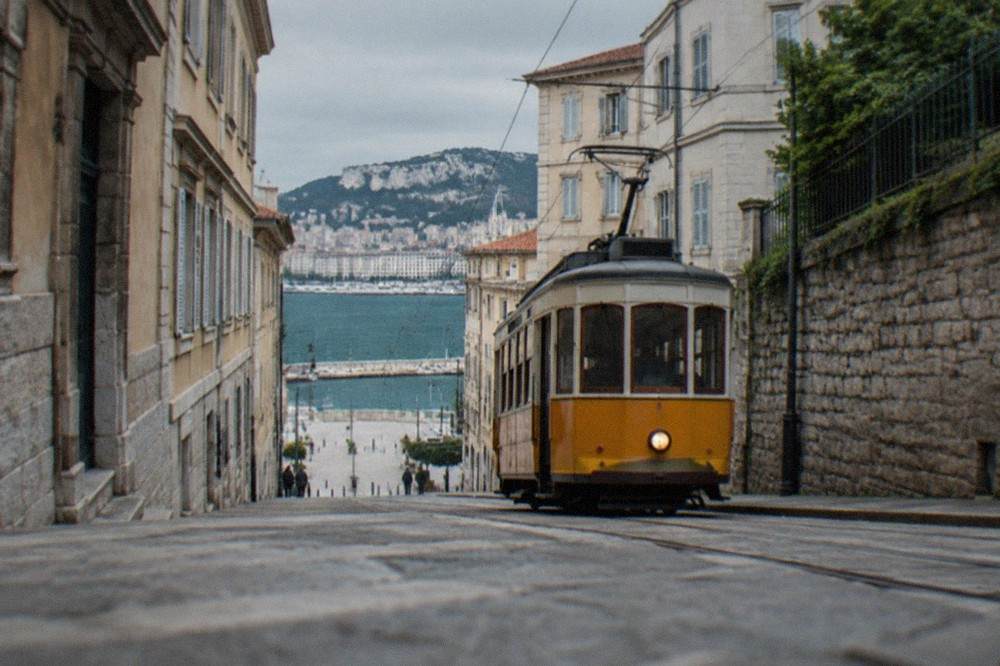
The route itself is the reason to ride rather than drive. The first stretch is ordinary street running through the city, and then the line tackles the escarpment: the cliff wall that lifts Trieste's coastal strip onto the Karst plateau. On the steepest section the cars are hauled by cable, funicular-style, between the Vetta Scorcola area and the top of the slope, which is why enthusiasts classify the Opicina tram as a hybrid rather than a pure tram. The view opens over the Gulf of Trieste as the line climbs, with the city, the seafront and the Molo Audace pier laid out below.
At the top the tram deposits you at Opicina station, the small rail-served village that is the gateway to the plateau. From there the plateau's own attractions fan out, from Villa Opicina itself to the great cave at Grotta Gigante. If you are planning wider travel in the region, the companion guide to getting around Trieste by bus, tram and taxi covers how line 2 fits into the rest of the network.
How Much Does the Opicina Tram Cost?
The Opicina tram costs the same as any Trieste urban bus ride, because it is part of the ordinary network. The 2026 tariff sheet lists a 60-minute single at €1.50, a 75-minute single at €1.85, a day ticket at €3.35, ten rides at €13.50 and twenty rides at €16.65. Contactless Mastercard, Visa and American Express cards and digital wallets can be tapped on board, and the system applies the cheapest applicable fare.
Those fares come from the operator's own "Tariffe 2026" sheet for the Trieste urban service, dated 29 December 2025. The day ticket is the one that matters for most visitors combining the tram with a day of city sightseeing: one €3.35 ticket covers the ride up, the ride down and any buses in between, provided you stay inside the validity rules.
| Code | Ticket | Validity | 2026 price |
|---|---|---|---|
| U01 | Urban single | 60 minutes | €1.50 |
| U02 | Urban single | 75 minutes | €1.85 |
| U24 | Day ticket | One day | €3.35 |
| U10 | 10 rides | Carnet | €13.50 |
| U20 | 20 rides | Carnet | €16.65 |
Two details in that tariff sheet are easy to miss. Single tickets are valid 60 or 75 minutes depending on which one you buy, and on Sundays and public holidays the validity extends to 240 minutes, which on a quiet Sunday is comfortably enough for a return trip to the plateau with a stop at the top. And the on-board "Eva" readers accept contactless payment directly, so you do not need to find a ticket machine before boarding the tram.
Before you plan the climb, it helps to have the city floor sorted, and a self-guided option is often the best fit for a tram day, because the tram's own timetable is the only fixed point you need to keep.
The same tour is worth a closer look if you like the sound of a walk with no schedules attached.
What Is the Obelisk Above Trieste?
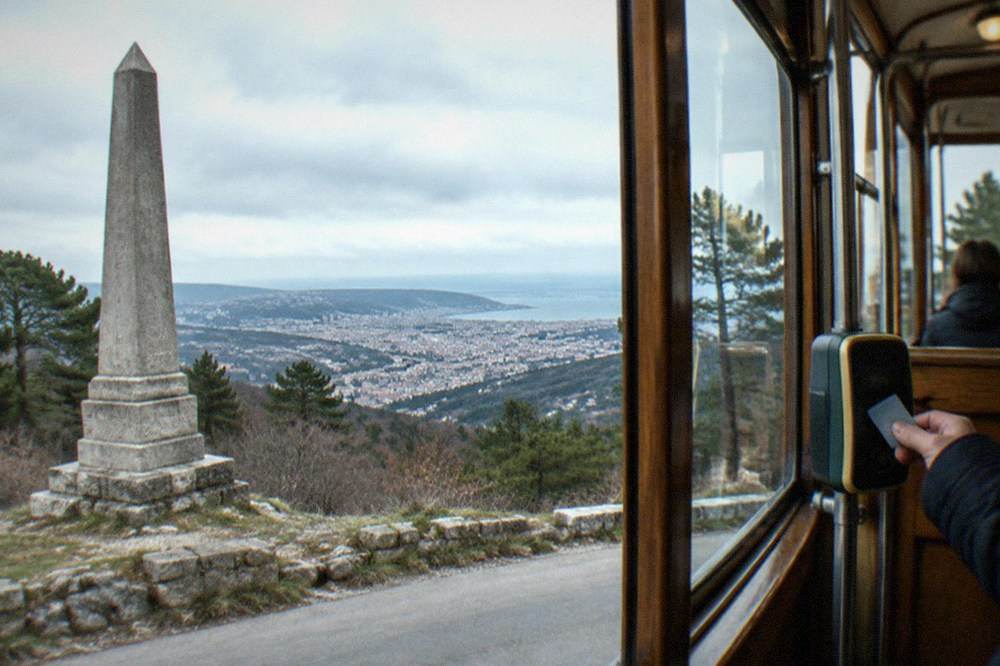
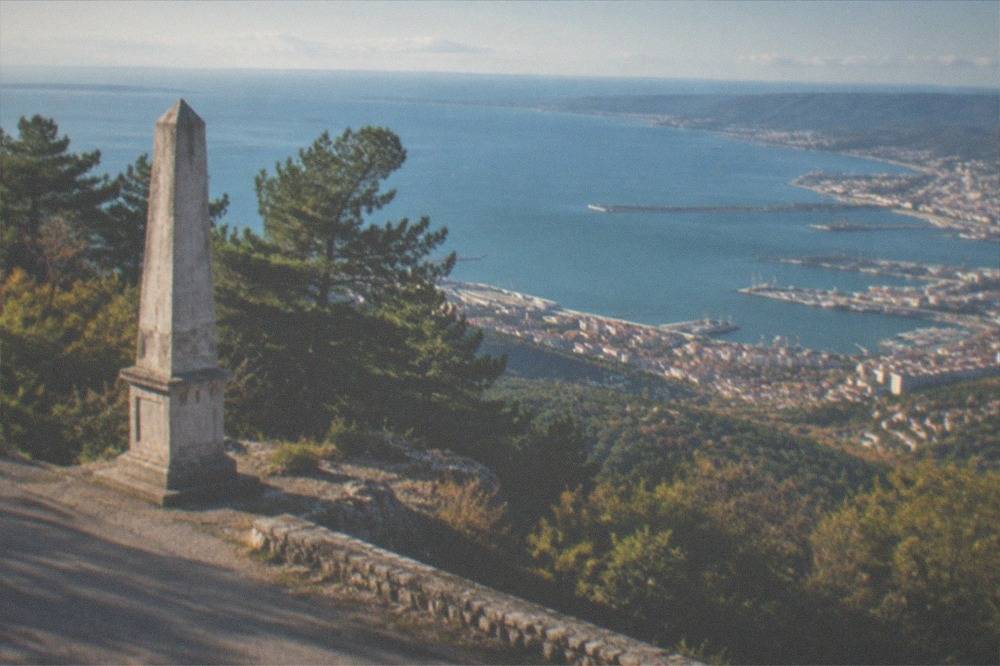
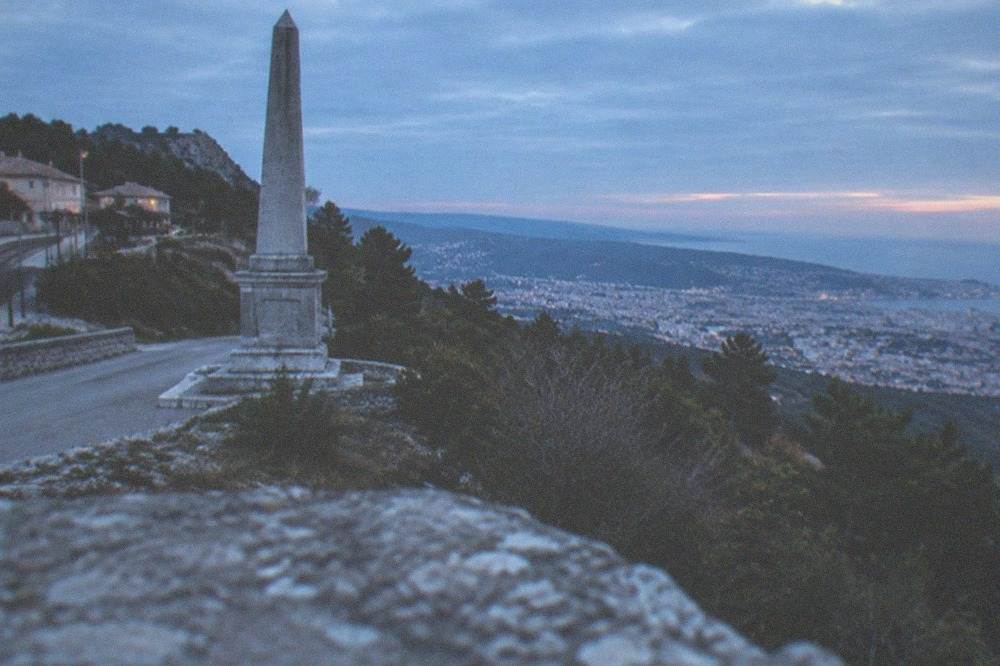
The Obelisk at Opicina is a stone monument standing beside the old road where it reaches the top of the Karst escarpment, and it gives its name to the Obelisco stop on the tram route, the second-to-last stop before Opicina station. It sits at the rim of the plateau, where the ground falls away toward the Gulf of Trieste, with the city, the seafront and the coast toward Miramare spread below, which is why the spot has long been a viewpoint rather than a pass-through.
The Obelisk's role in a visit is practical as much as historical: it marks where the climb ends and the plateau begins. Get off the tram at Obelisco and you are standing at the edge with the drop to the city behind you and the dry stone landscape of the Karst ahead. The stop is a natural half-way house for photographers, because the platform area looks back over the gulf, and on a clear day the line of the coast runs out toward Miramare Castle on its promontory.
What you do with the stop depends on the day. In clear weather the panorama over Trieste is the reason to pause here, with the Piazza Unità d'Italia waterfront and the San Giusto hill identifiable below. When the bora is blowing hard from the east-north-east, the rim of the plateau is exactly where the wind is at its rawest, and the sensible plan is to stay on the car to Opicina and view the escarpment from indoors with a coffee.
The Obelisk is also where the tram's two halves meet in the imagination. The street-running section below and the plateau section above are different worlds: Italian cafe streets below, wind-brushed limestone and Slovene-influenced villages above. The monument happens to stand at the seam, which is a good enough reason for it to have become the named landmark of the whole upper section.
What Can You Do from Opicina Station?
Opicina station is the tram's upper terminus and the practical gateway to the Trieste Karst: from it you can walk the plateau village, continue by train along the plateau line, or reach the Grotta Gigante cave at Sgonico, which is a short bus or car hop from Opicina territory. The cave is guided-only with compulsory booking, adults €15, children 6 to 18 €8, and it is closed on Mondays from September to February.
The cave deserves the headline because it is the plateau's biggest single attraction and the tram is the scenic way to approach the plateau that contains it. Grotta Gigante's own price list and schedule pages give the figures above, plus departures at 9:00, 10:00, 11:00, 12:00, 14:00, 15:00 and 16:00, and the venue asks you to book in advance by phone or email. From September to February it opens Tuesday to Sunday; from March to August it opens every day. The wider set of guides lives on Trieste Travel Guide.
| Attraction | Where | Entry | Key rule |
|---|---|---|---|
| Grotta Gigante | Sgonico, on the Karst | €15 adult, €8 child 6-18 | Guided only, booking compulsory |
| Miramare Castle park | Grignano, on the coast | Free all year | Park and castle keep different hours |
| Miramare Castle | Grignano | €17 adult | Open daily 9:00-19:00, last entry 18:30 |
| Risiera di San Sabba | South Trieste | Free | Daily; groups book March to May |
| Cathedral of San Giusto | San Giusto hill | Free | Avoid Mass times |
Back at the plateau's rim, the walking options are quieter but real. The village around Opicina station is small, and the plateau behind it is the landscape of the Karst plateau guide's dry walls, sinkholes and osmize, the farm cellars that open seasonally and hang a leafy frasca branch at the turning when they do. The osmize calendar lives at osmize.com and is the de facto listing of which farms are open on which days.
For a self-paced alternative to the guided walks in the centre, an audio and written guide produced by a local covers Trieste's streets and lets you set your own schedule, which suits the flexible day the tram makes possible: up the escarpment in the morning, back down for the afternoon.
When Is the Best Time of Year to Ride the Opicina Tram?
The best time to ride the Opicina tram is late spring through early autumn, when the bora is at its weakest and the plateau views are clearest. ARPA FVG's station tables for Trieste molo Fratelli Bandiera show June as the calmest month of the year for wind, with an average of just 2.2 days with a gust over 72 km/h, while February averages 6 such days and carries the series' all-time peak gust of 168.1 km/h, recorded in February 2012.
The wind numbers matter more on this line than on any other urban route in Italy, because the upper section runs along the exposed rim of the escarpment, and the bora, which ARPA's regional wind sheet describes as blowing from the east-north-east with gusts that "largely exceed 100 km/h", is a fact of Trieste life rather than a rare event. The station tables count 49 days a year on average with a gust over 72 km/h and 17.6 days with a gust over 90 km/h.
| Month | Mean high C | Rain mm | Days gust over 72 km/h | Days gust over 90 km/h |
|---|---|---|---|---|
| April | 16.8 | 60.7 | 3.5 | 0.7 |
| May | 21.7 | 75.0 | 2.7 | 0.7 |
| June | 25.8 | 62.5 | 2.2 | 0.3 |
| July | 28.2 | 53.8 | 3.3 | 0.9 |
| August | 28.1 | 71.7 | 2.9 | 0.9 |
| September | 23.9 | 102.3 | 3.5 | 1.1 |
| October | 19.6 | 88.6 | 4.0 | 1.4 |
| November | 14.7 | 109.8 | 5.2 | 1.9 |
Two readings of that table are useful. Summer is not the windless season people assume: July actually averages more days over 90 km/h than April, May or June, so a strong gust in July is not a freak. And the shoulder of the year, October and November, is when both rain and wind climb together, with November the wettest month at the molo at 109.8 mm. A winter ride is perfectly possible and the plateau under a bora sky is dramatic, but go prepared for wind that will take your hat and make the viewpoint stop a brief one.
No published wind threshold exists at which the tram, the Rive or the ferries stop running; the operator and the authorities scale their responses to live conditions rather than a fixed cutoff, so do not plan around a number you may see quoted elsewhere. Check the operator's status page on the day, and treat a bora forecast as a reason to ride the tram and admire the wind rather than a reason to cancel.
How Does the Opicina Tram Climb the Cliff?
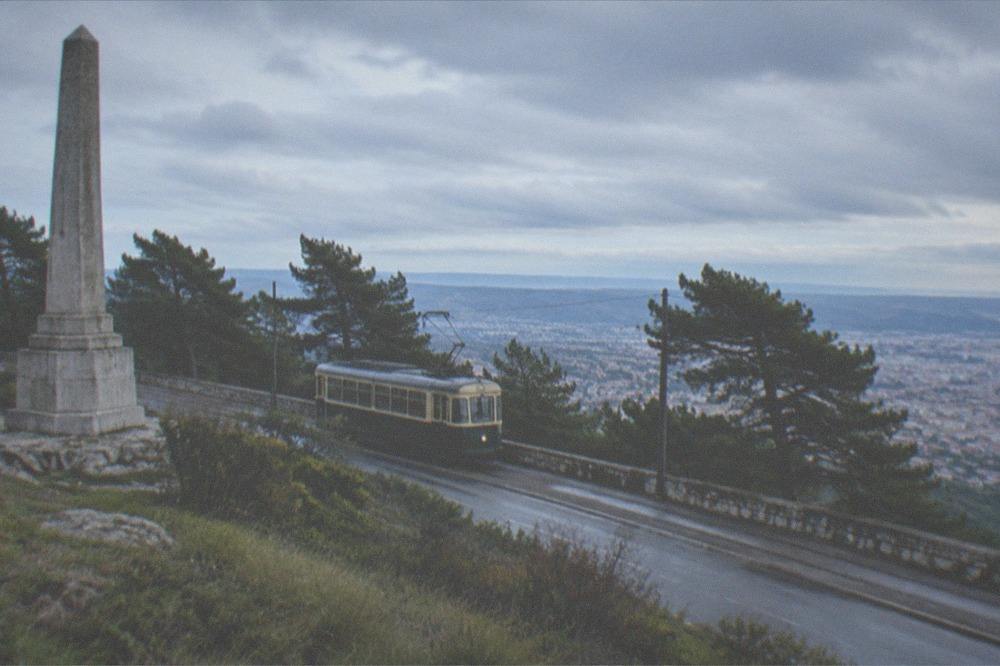
The Opicina tram climbs the escarpment as a hybrid: it runs as an ordinary electric tram on the city streets and through most of the route, but on the steepest section of the slope the cars are hauled by cable, funicular-style, which is why the operator's own notices refer to maintenance on the funicular system. This mixed traction is the line's defining engineering trait and the reason it is studied rather than merely ridden.
The details of how the haulage works belong to the operator's technical pages, and this article will not dress them up beyond what the sources say. What a rider actually experiences is simpler: a normal tram ride that suddenly feels pinned to a gradient, a pause as the cable section is negotiated, and then the release onto the plateau. Passengers who know the line's reputation for the view sit on the seaward side for the climb.
For context on how rare this arrangement is, consider what the rest of the region offers. The Victory Lighthouse, Faro della Vittoria, the Rilke Trail above Duino and the escarpment paths of the Karst all give you the same cliff on foot, but only line 2 gives it to you seated, in a vehicle old enough that the ride itself is the exhibit. The line's longevity is the point: it predates every other form of motorised public transport still running in the city.
Planning around the climb needs one honest note. The published timetable does not state a journey time or a frequency in the material verified for this page, and neither will be invented here. What is verified is the route, the length of about 5.175 km, the termini and the ticketing. For the timetable itself, the operator's line-2 page carries the current PDF, and that is the document to plan from, because it is the one the operator keeps current.
If your taste runs to the corners most itineraries skip, a private hidden-gems walk with a local guide covers the city's quieter streets and courtyards, and it pairs well with a tram afternoon, since the guide's route stays in the centre while the tram takes you above it.
How Do You Fit the Tram Into a Day in Trieste?
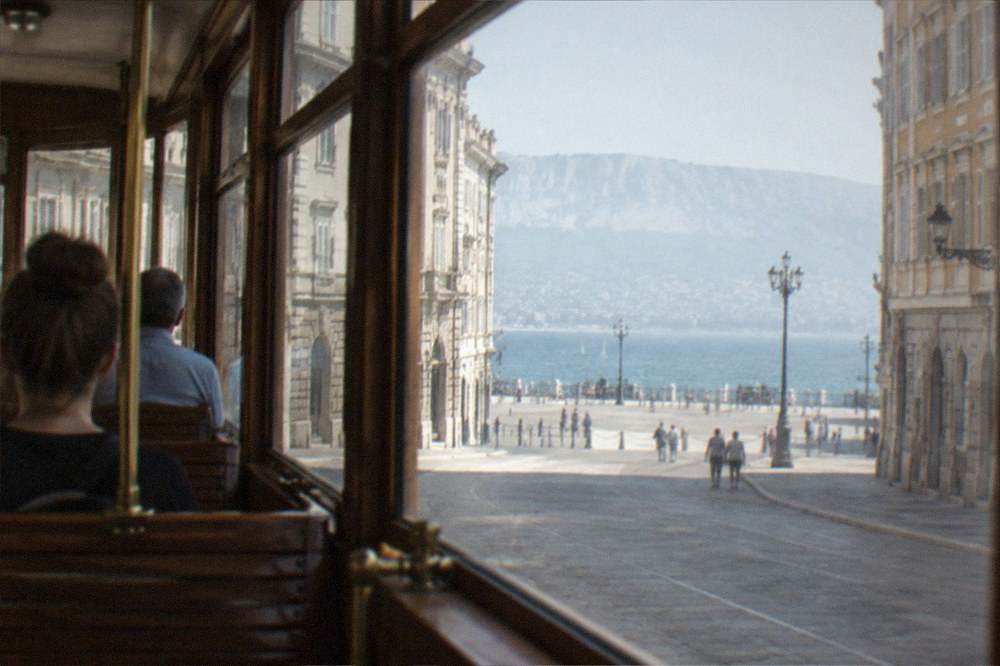
A workable plan is to spend the morning in the centre, around Piazza Unità d'Italia, the San Giusto hill and the Città Vecchia, ride the tram up after lunch from piazza Dalmazia, pause at the Obelisco stop for the panorama, and take a late-afternoon car back down in time for an aperitivo on the waterfront. The day ticket at €3.35 covers both tram rides and the buses between the centre and piazza Dalmazia.
The order can be reversed in summer, when the plateau is better in the relative cool of the morning and the city in the evening, but the principle holds: the tram is a half-day experience that slots into a city day rather than competing with it. If you are working from a short-stay plan, the one day in Trieste itinerary and the two days in Trieste itinerary both leave room for it.
| Time of day | Where | Why it works |
|---|---|---|
| Morning | Piazza Unità d'Italia and Molo Audace | The waterfront before the crowds build |
| Late morning | San Giusto hill and cathedral | Free entry, city views, then lunch below |
| Early afternoon | Piazza Dalmazia terminus | Catch line 2 up the escarpment |
| Mid afternoon | Obelisco stop and Opicina | The panorama and the plateau air |
| Late afternoon | Return tram to piazza Dalmazia | Day ticket still valid, light on the sea |
Visitors arriving by ship should note that the tram also fits a cruise day, and the cruise shore excursions guide explains how the terminus relates to the port area. The ride up and back, with a stop at the top, is a compact excursion that leaves the rest of the day for the centre, and unlike the paid excursions it costs the price of a day ticket.
For those who prefer a guided frame around the city's history, a private Jewish heritage walking tour covers one of Trieste's deepest cultural stories, the port's role as a gateway for generations of emigrants, and it runs about three hours, leaving the rest of the day free for the tram.
Common Questions About the Opicina Tram in Trieste
Is the Opicina Tram Running?
Yes. The line was reactivated on 1 February 2025 after the stop that followed the August 2016 collision, and Trieste Trasporti's line-2 page carries a current timetable dated 20 July 2026. Check the operator's live status on the day you ride for any short maintenance notice.
Where Does the Opicina Tram Leave From?
From piazza Dalmazia in Trieste, not piazza Oberdan. The published route runs piazza Dalmazia, piazza Casali, Sant'Anastasio, via Romagna, Vetta Scorcola, Cologna, Conconello, Obelisco and Opicina station, about 5.175 km in total.
How Much Is the Opicina Tram?
The ordinary urban fare applies: €1.50 for a 60-minute single, €1.85 for 75 minutes, or €3.35 for a day ticket on the 2026 tariff sheet. Contactless cards can be tapped on board and the system applies the cheapest applicable fare.
Is the Opicina Tram a Funicular?
Partly. It runs as an ordinary tram for most of the route, but on the steepest section of the escarpment the cars are hauled by cable, which is why the operator's notices refer to maintenance on the funicular system. It is one of the few hybrid tram-funicular lines in the world.
Can You Visit Grotta Gigante from Opicina?
Yes, the cave at Sgonico sits on the Karst that the tram gives you access to, and a short bus or car hop connects the plateau to the cave area. Grotta Gigante is guided-only with compulsory booking, adults €15 and children 6 to 18 €8, and it is closed on Mondays from September to February.
Is the Obelisk Worth Stopping For?
Yes, if the weather is clear. The Obelisco stop sits at the rim of the escarpment with the whole Gulf of Trieste below, and it is the second-to-last stop before Opicina station. In a strong bora, stay on the car and admire the view through the window instead.
The tram de Opicina is the one Trieste attraction that is simultaneously a museum piece and a commuter service, and the operator's own pages are the living proof that it works: a current timetable, a published route from piazza Dalmazia, and an ordinary urban ticket that covers the climb. Ride it while the light is on the gulf, stop at the Obelisk if the wind allows, and you will have done the thing most visitors to Trieste, and most guides writing about it, still believe is impossible.