Trieste Weather Month by Month: Rain, Heat and the Bora, Italy's Adriatic Port
Trieste, in the far northeast of Italy, has a climate most guidebooks get wrong: its rain falls in autumn, its summer is one of the driest stretches of the year, and its wind can stop you on the pavement. Here is the month by month picture from the regional weather agency's own station tables.
Short answer
Trieste's wettest month is November at 109.8 mm, September is second at 102.3 mm, and July is one of the driest at 53.8 mm, so rain here is an autumn problem, not a summer one. Annual mean air temperature is 15.9 C and annual rainfall is 867.1 mm across 86.1 wet days.
Trieste, the Adriatic port city in Friuli Venezia Giulia in the northeast of Italy, has a climate that almost every summary written at a distance gets wrong. The city is not a rainy Mediterranean summer town, and it is not a sheltered southern Italian beach resort. Its rain arrives in autumn, concentrated in September and November, its summers are among its driest stretches of the year, and its wind, the bora, can hit harder in any month than most visitors expect. Every figure on this page comes from the regional weather agency's own station tables for the Trieste molo Fratelli Bandiera station, series 1995-2024, which is the best continuous record that exists for this exact stretch of waterfront.
This guide is the reference page this site's Trieste Travel Guide uses when another article needs to answer "but what will the weather actually do?" It goes month by month, then season by season, then answers the practical questions: when it rains, when it is hot, when the sea is warm enough to swim, when the bora is likely, and what to pack. The neighbour article on the best time to visit Trieste covers the planning question; this one covers the weather itself.
What Is the Overall Climate of Trieste, Italy?
Trieste has a humid temperate coastal climate with an annual mean air temperature of 15.9 C, annual rainfall of 867.1 mm spread across 86.1 wet days, and no month that is dry in absolute terms: the driest months still average more than 52 mm of rain. Winters are mild rather than cold, summers are warm but not brutal, and the dominant weather story is the wind, with 49 days a year on average carrying a gust over 72 km/h.
Those numbers come from the station tables of ARPA FVG, the regional environmental agency, measured at the molo Fratelli Bandiera on the waterfront, one metre above sea level. That placement matters. Trieste sits at the head of its gulf with the Carso plateau immediately behind it, so the city's weather is shaped by two forces: open water in front and limestone karst behind. The plateau drains cold air down onto the coast, which is one reason the winter stays above freezing on average and one reason the wind channels the way it does.
The agency's tables also break down the extremes. In an average year the city records 18.8 days over 30 C, and nearly all of them fall in July and August. The all-time peak gust in the 1995-2024 series is 168.1 km/h, measured in February 2012. Nothing about that is summer-only: the monthly record gust exceeds 110 km/h in every single month of the year, which is a fact worth holding on to before you assume a July trip is wind-proof.
How Much Rain Does Trieste Get Each Month?
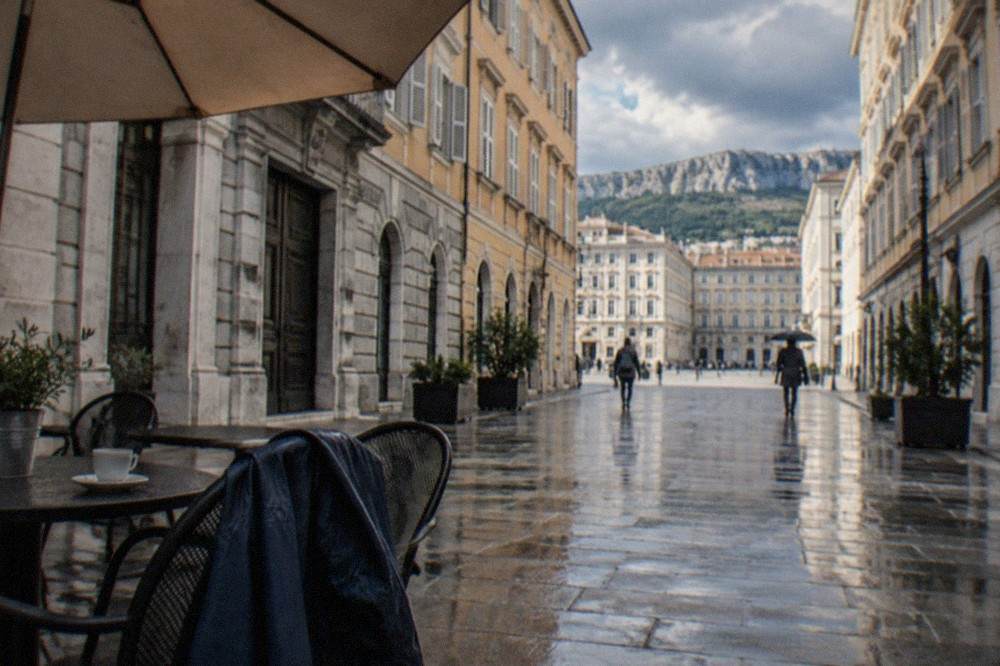
The rain in Trieste is an autumn story: November is the wettest month at 109.8 mm, September is second at 102.3 mm and October takes 88.6 mm, so the three autumn months together dominate the year's rainfall. The driest stretch is late winter and early spring, with January and March tied at 52.8 mm and July second driest at 53.8 mm, and the annual total across the whole series is 867.1 mm over 86.1 wet days.
Wet days, counted as days with at least 1 mm of rain, tell the same story from a different angle. November averages 9.5 of them, October 7.6 and September 7.4. In contrast, June averages 6.1 wet days and July just 5.4. So a summer week in Trieste is more likely to be dry than a summer week in many better-known Italian destinations, and the season to plan around rain is autumn.
| Month | Rain mm | Wet days (1 mm or more) | Rank by rainfall |
|---|---|---|---|
| January | 52.8 | 6.6 | Joint driest |
| February | 59.7 | 6.6 | 10th |
| March | 52.8 | 6.1 | Joint driest |
| April | 60.7 | 8.0 | 9th |
| May | 75.0 | 8.5 | 8th |
| June | 62.5 | 6.1 | 7th |
| July | 53.8 | 5.4 | 4th |
| August | 71.7 | 6.6 | 6th |
| September | 102.3 | 7.4 | 2nd |
| October | 88.6 | 7.6 | 3rd |
| November | 109.8 | 9.5 | Wettest |
| December | 77.4 | 7.7 | 5th |
Two practical readings follow. First, the "rainy Trieste" reputation comes from November, not from any summer month, and it is a real reputation: the city's total is higher than many southern Italian coastal areas. Second, May is the month that quietly underperforms its reputation: 75 mm and 8.5 wet days make it wetter than the average June or July, and a wetter month than December by rainfall total. Travellers who assume late spring is reliably dry are often surprised.
One more caution that belongs on this page because it is a weather page. The 867 mm figure is the waterfront station's own measurement. Grid-based climate datasets that cover this location with a coarse land cell are contaminated by the Carso plateau behind the city and report annual rainfall wrong for the city by 72 percent on rain. If you see Trieste quoted as one of the wettest cities in Italy on the strength of those datasets, that is a data artefact, not a fact about the waterfront.
What Are the Temperatures in Trieste Month by Month?
Mean daily temperatures in Trieste run from 7.1 C in January and 7.4 C in February up to 25.2 C in both July and August, with mean highs peaking at 28.2 C in July and 28.1 C in August, and mean lows staying above 5 C in every month of the year. The city records 18.8 days over 30 C in an average year, nearly all of them in July and August, and zero days over 30 C on average from November through April.
The table gives the full picture. Note the winter lows: a mean January low of 5 C is mild by continental standards, and the sea, which never drops below an average of 10.5 C, is part of the reason. Note also how flat the shoulder seasons are: April's mean of 14 C sits between October's 17.1 C and March's 10.4 C, which is why spring and autumn days in Trieste can feel almost interchangeable until the wind reminds you which season it is.
| Month | Mean high C | Mean C | Mean low C | Days over 30 C |
|---|---|---|---|---|
| January | 9.2 | 7.1 | 5.0 | 0 |
| February | 9.8 | 7.4 | 5.2 | 0 |
| March | 13.0 | 10.4 | 7.9 | 0 |
| April | 16.8 | 14.0 | 11.4 | 0 |
| May | 21.7 | 18.8 | 16.1 | 0.1 |
| June | 25.8 | 23.1 | 20.2 | 2.5 |
| July | 28.2 | 25.2 | 22.4 | 7.2 |
| August | 28.1 | 25.2 | 22.3 | 8.5 |
| September | 23.9 | 21.2 | 18.4 | 0.5 |
| October | 19.6 | 17.1 | 14.8 | 0 |
| November | 14.7 | 12.5 | 10.3 | 0 |
| December | 10.7 | 8.5 | 6.4 | 0 |
August is the month with the most days over 30 C, 8.5 on average, narrowly ahead of July's 7.2. Neither is extreme by Italian summer standards, and the humidity is moderated by the gulf. What makes a Trieste heatwave feel different from a Roman one is that the same sea that keeps nights above 22 C in July also keeps the daytime honest with an onshore breeze, right up until the breeze turns into something else and starts blowing from the east-north-east.
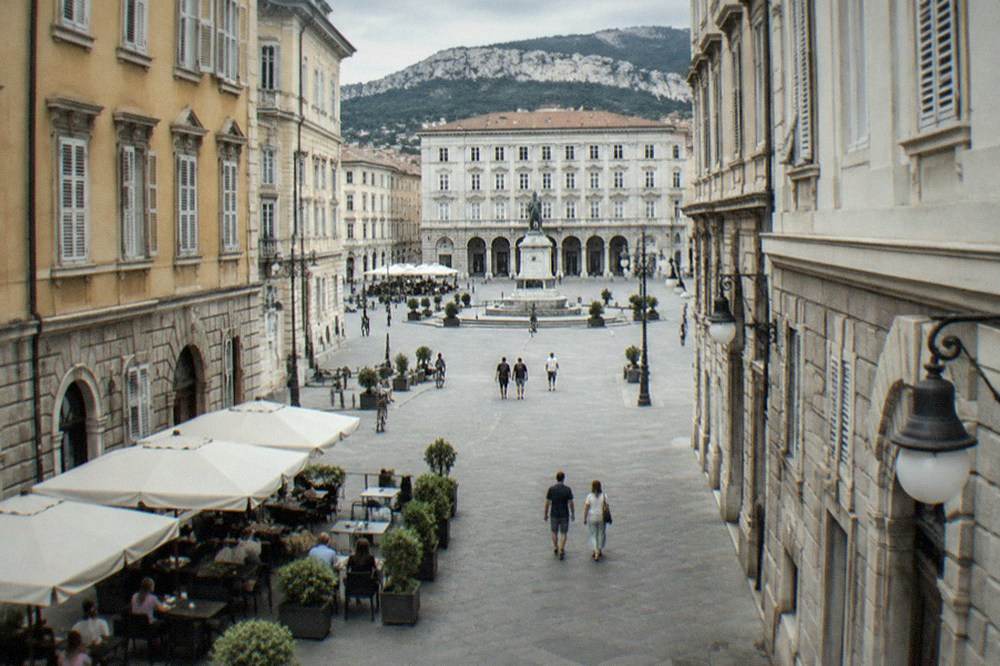
A hot afternoon in Trieste is an eating-and-drinking afternoon, and the city's food culture handles heat well: the buffet tradition of simple open sandwiches and the shaded tables of the historic caffè both work in August. The city's food guide and the coffee culture guide cover what to order, and the coffee houses in particular are the classic bad-weather refuge, which in Trieste means both the November rain and, occasionally, a bora day that closes the outdoor tables.
When Is the Best Month to Visit Trieste for Good Weather?
The best weather months for most visitors are June and September: June averages 25.8 C as a mean high with only 62.5 mm of rain and the calmest wind of the year, while September still reaches 23.9 C on average and has the warmest sea of any month at 23.9 C, though it is also the second wettest month at 102.3 mm. May and July each suit a different traveller, May for wildflowers and fewer crowds, July for the warmest and among the driest days.
There is no single answer, because Trieste's weather trades off three separate things: rain, heat and wind. June wins on balance. It is the calmest month for wind in the whole station table, averaging 0.3 days with a gust over 90 km/h, and it combines that with full summer temperatures and less rain than either April or May. September has the warmest sea of the year, warmer than August on average, because the water holds its heat longer than the air, but it carries autumn's rain and the first of the season's stronger bora episodes.
The full comparison is easier to read than to argue:
| Month | Mean high C | Rain mm | Days gust over 72 km/h | Sea C | Verdict |
|---|---|---|---|---|---|
| April | 16.8 | 60.7 | 3.5 | 14.0 | Cool and green |
| May | 21.7 | 75.0 | 2.7 | 17.9 | Warm, spring showers |
| June | 25.8 | 62.5 | 2.2 | 23.1 | Best balance |
| July | 28.2 | 53.8 | 3.3 | 25.9 | Hottest, very dry |
| August | 28.1 | 71.7 | 2.9 | 25.9 | Hot, warm sea |
| September | 23.9 | 102.3 | 3.5 | 23.9 | Warm sea, autumn rain |
| October | 19.6 | 88.6 | 4.0 | 20.3 | Mild, windy shoulder |
October deserves its own sentence, because it is the month the city's biggest event occupies. The Barcolana regatta fills the gulf in the second week of October, an event that exists precisely because October sits inside the windy shoulder: 4.0 days on average with a gust over 72 km/h, and a month in which the record gust has reached 126 km/h in the 1995-2024 series. The regatta has raced in that window since 1969 and the racers plan for it. Spectators should pack a serious jacket.
How Strong Is the Bora Wind Month by Month?
The bora is Trieste's defining weather feature: the station records 49.0 days a year on average with a gust over 72 km/h and 17.6 days over 90 km/h, and the all-time peak in the series is 168.1 km/h measured in February 2012.
February is the windiest month with 6.0 days over 72 km/h and 2.9 days over 90 km/h, June is the calmest with 0.3 days over 90 km/h, and the monthly record gust exceeds 110 km/h in every month of the year.
The bora blows from the east-north-east, cold air spilling off the Carso plateau and down onto the coast, and it is a katabatic wind rather than a storm: the sky can be perfectly clear while the gusts strip leaves off the trees along the Rive. The wind is most frequent in the cool season, November through March, peaking in February, and it can persist for days. Rarer and weaker episodes occur in summer, and the calmest stretch runs from late May into June.
| Month | Days gust over 72 km/h | Days gust over 90 km/h | Record gust km/h |
|---|---|---|---|
| January | 5.5 | 2.4 | 148 |
| February | 6.0 | 2.9 | 168 |
| March | 4.9 | 2.1 | 163 |
| April | 3.5 | 0.7 | 123 |
| May | 2.7 | 0.7 | 120 |
| June | 2.2 | 0.3 | 110 |
| July | 3.3 | 0.9 | 125 |
| August | 2.9 | 0.9 | 124 |
| September | 3.5 | 1.1 | 124 |
| October | 4.0 | 1.4 | 126 |
| November | 5.2 | 1.9 | 147 |
| December | 5.3 | 2.3 | 133 |
Read that table twice, because it contradicts two assumptions. July averages more gale days than April, May or June: 0.9 days over 90 km/h against 0.7, 0.7 and 0.3. And there is no month of the year in which the record gust stays under 110 km/h. The full physics of the wind, including what it does to the sea and to the city's streets, is on the bora wind guide.
One thing this site will not do is publish a wind speed at which the seafront closes or the ferries stop. No official threshold of that kind was found on any agency or authority page. In practice, strong bora episodes do disrupt maritime traffic and the waterfront, and the authorities react in real time rather than to a number. Check the live forecast and the operator's own notices, not a cutoff figure someone invented.
How Warm Is the Sea in Trieste for Swimming?
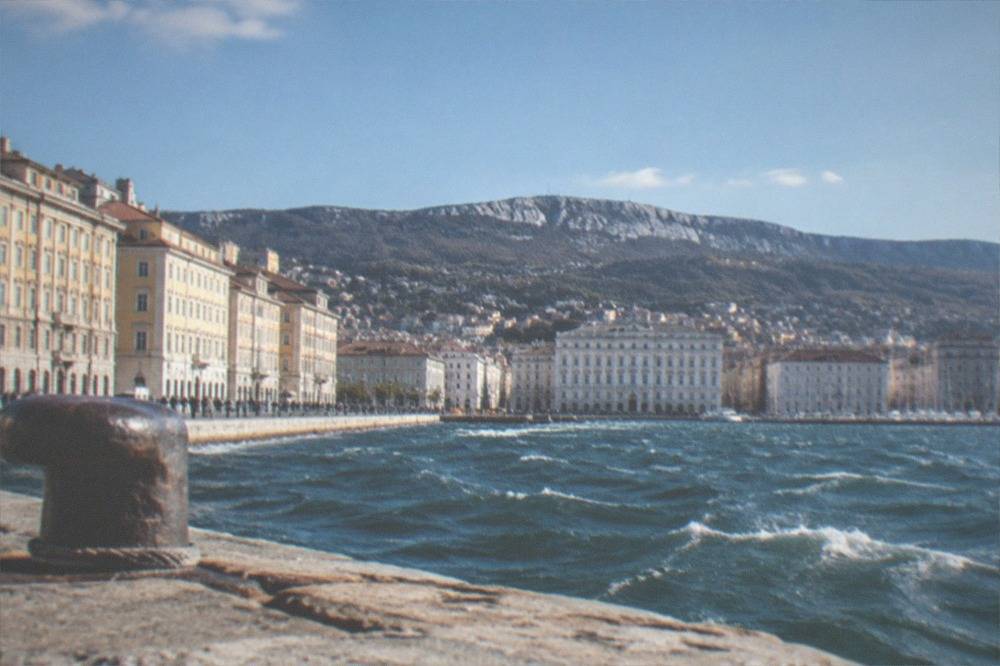
The sea in the Gulf of Trieste averages 25.9 C in both July and August as its annual maximum, holds 23.9 C in September and 23.1 C in June, and drops to its minimum of 10.5 C in February. Comfortable swimming, in the low twenties and above, is a June-through-September condition, with September the warmest month for the water relative to the air.
Sea temperature behaves differently from air temperature because water changes slowly. The gulf warms through spring, peaks at the height of summer, and then cools far more gradually than the air does, which is why early autumn swims in Trieste are a local habit rather than bravado. The same thermal lag explains a June-September asymmetry: June can be a hot month on land while the sea still carries spring's chill, while September can feel cool on the seafront while the water remains at its summer best.
| Month | Mean sea temperature C | Swimming verdict |
|---|---|---|
| January | 11.6 | No |
| February | 10.5 | No, annual minimum |
| March | 11.6 | No |
| April | 14.0 | Hardened locals only |
| May | 17.9 | Marginal |
| June | 23.1 | Yes |
| July | 25.9 | Peak |
| August | 25.9 | Peak |
| September | 23.9 | Yes, warmest air-to-water gap |
| October | 20.3 | Possible in a warm spell |
| November | 16.8 | No |
| December | 13.6 | No |
Where to swim, including the city's own historic bathing establishments and the pebble coves along the coast, is covered in the beaches and swimming guide. The water temperature question and the wind question interact: a strong bora pushes cold water around the gulf and makes any sea day a non-starter, sea temperature notwithstanding. On a calm July day the sea and the air agree perfectly.
What Is Trieste Weather Like in Spring?
Spring in Trieste warms quickly on paper, from a March mean of 10.4 C to an April mean of 14.0 C and a May mean of 18.8 C, but it is not a dry season: April averages 60.7 mm of rain across 8.0 wet days and May 75.0 mm across 8.5 wet days, so May is wetter than the average June or July. March is the joint driest month of the year at 52.8 mm, tied with January.
March is the month visitors underestimate. It is the driest month in the whole table, the windiest of the spring trio with 4.9 days over 72 km/h, and the month in which the Carso's wildflowers begin while the sea sits at just 11.6 C. Days feel sharp and bright rather than warm. By late April the mean high reaches 16.8 C, and by May the city is properly warm, but with almost nine wet days a month, packing for May means packing for both.
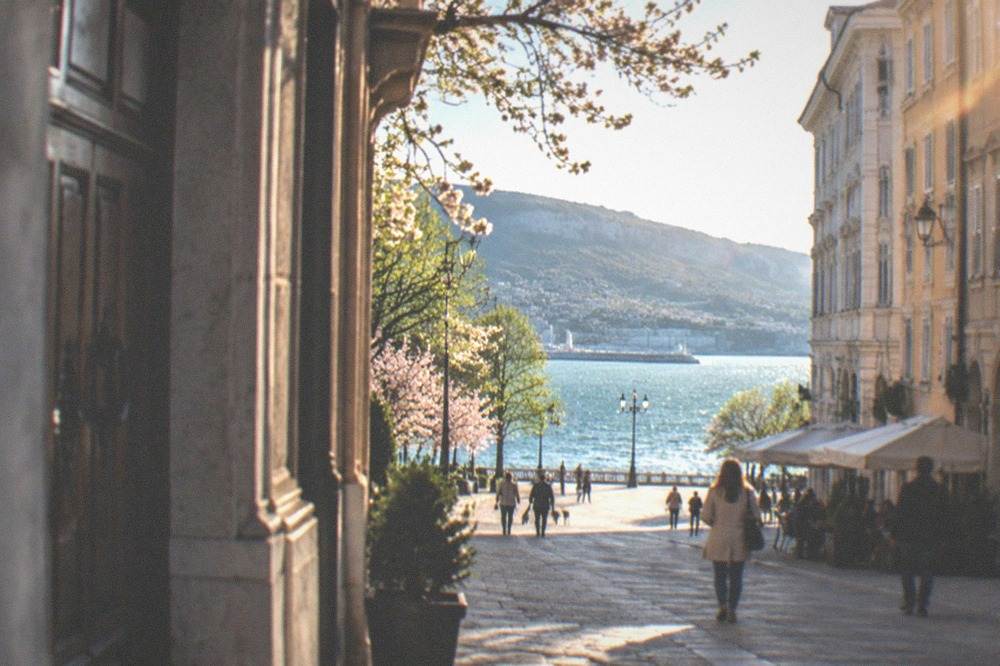
Spring is also the season of the osmize, the Karst farmhouses that open their cellars and sell their own wine and produce direct, signposted by a frasca, a leafy branch hung at the turning. The custom runs mainly in spring and autumn, and a cool bright March or April Saturday is the classic day to climb onto the plateau. The osmize guide explains the calendar and the etiquette. The plateau sits a few hundred metres above the city and is reliably cooler and windier than the waterfront, which is a fact worth remembering every time you plan to leave the coast.
What Is Trieste Weather Like in Summer?
Summer in Trieste is warm rather than extreme: July and August both average 25.2 C as a mean daily temperature, with mean highs of 28.2 C and 28.1 C, and the two months together account for nearly all of the year's 18.8 days over 30 C. Rain is modest, at 53.8 mm in July and 71.7 mm in August, and June is the calmest month of the year for wind, averaging 0.3 days with a gust over 90 km/h.
The summer deserves its dry reputation, with a caveat. August, at 71.7 mm, is wetter than most of the months around it, and it carries 6.6 wet days. When rain comes in a Trieste summer it tends to come as a thunderstorm rather than a week of drizzle, and the wettest stretch of the year begins in September. For planning purposes, July is the city's driest month alongside its neighbours, and a July day is more likely to be wind-free than an October one.
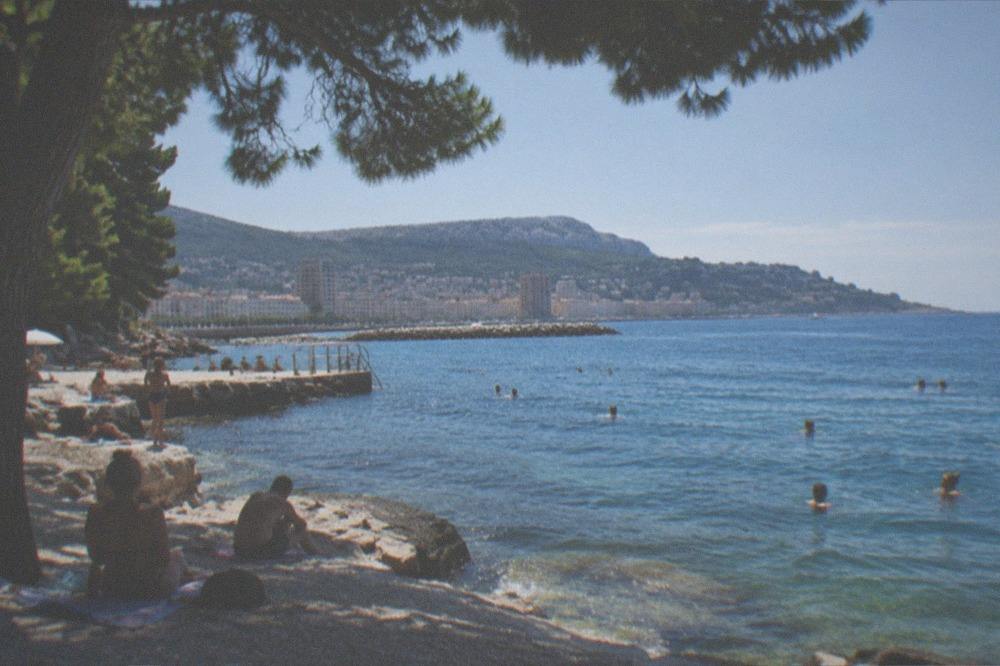
The practical summer questions are where to swim and where to eat in the heat, and both are well served: the bathing establishments fill up in August, and the shaded squares of the Città Vecchia stay a few degrees gentler than the open Rive. June averages 15.68 hours of daylight, the longest of any month, and the sea breeze that makes the afternoons bearable is the same mechanism that turns the water choppy on a windy day. When the forecast turns easterly, expect the Rive to be an unpleasant walk and the swimming to be short.
What Is Trieste Weather Like in Autumn?
Autumn is the season to plan around: September, October and November carry 102.3 mm, 88.6 mm and 109.8 mm respectively, dominating the year's rainfall, and November alone averages 9.5 wet days, the highest of any month. Temperatures fall steadily from a September mean of 21.2 C to a November mean of 12.5 C, and the wind strengthens through the season toward winter.
September is a genuinely two-faced month and the honest advice is to treat it as a coin with a warm side. It holds the year's warmest sea at 23.9 C and a mean high of 23.9 C, days that feel like a mild summer, and it is also the second wettest month of the year. The rain that does fall tends to arrive in concentrated spells. October then turns the corner: the mean high drops to 19.6 C, the sea to 20.3 C, the wind days climb to 4.0 over 72 km/h, and the Barcolana takes over the gulf.
By November the city is in its rainiest and one of its greyest phases: 14.7 C mean high, 9.5 wet days, and 5.2 days with a gust over 72 km/h. It is not a month to avoid so much as a month to pack for properly, and indoor Trieste is strong: museums, the historic caffè, the covered Galleria and the Teatro Romano's stones seen from the street. The free things to do guide and the indoor-heavy suggestions on the unusual things to do guide both work well in November weather.
What Is Trieste Weather Like in Winter?
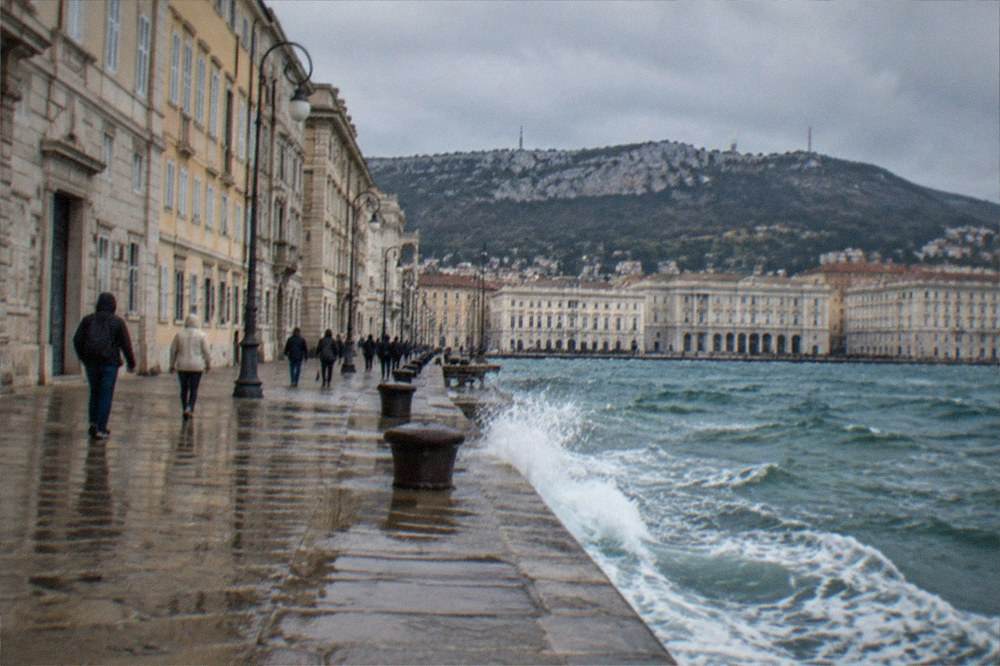
Winter in Trieste is mild and windy rather than cold: January averages 7.1 C as a mean daily temperature with a mean low of 5.0 C and a mean high of 9.2 C, and December averages 8.5 C, while both are among the drier months of the year at 52.8 mm and 77.4 mm.
The wind is the season's real feature, with January averaging 5.5 days with a gust over 72 km/h and February the windiest month of the year at 6.0 days.
Snow is rare and rain is modest, so a Trieste winter is mostly a matter of wind chill. The bora can gust to well over 100 km/h in any winter month, with record gusts in the series of 148 km/h in January, 168 km/h in February, 163 km/h in March and 133 km/h in December, and the city's streets respond in kind: the historic centre has its own wind-aware layout, with some passages funnelling and others sheltering, and locals simply know which side of a street to walk on. Daylight is short in December at 8.72 hours on average,
What to do with a cold windy day is a solved problem here. The city's indoor life is unusually dense: the caffè described in the coffee culture guide, the museums, and the covered shopping arcades between Piazza Unità d'Italia and Piazza della Borsa all sit within a compact, mostly flat rectangle. If the weather holds, the neighbourhood guide explains which parts of town keep a winter visit walkable.
What Should You Pack for Trieste Month by Month?
Pack for the wind, not just the temperature: Trieste needs a windproof layer in every month of the year, because the monthly record gust exceeds 110 km/h in all twelve months, and even the summer months average gust days over 72 km/h. Rain gear matters most from September through December, sunglasses matter most from May through August, and the one item that changes fundamentally by season is footwear: sturdy and warm in winter, anything in July.
The packing table below is deliberately conservative, because the failure mode of a Trieste trip is being underdressed for wind rather than for heat. A visitor who packs for the mean temperature and ignores the wind statistics will be cold in April and buffeted in October.
| Month | Daytime feel | Key item | Weather risk to plan around |
|---|---|---|---|
| January | Cold, bright spells | Windproof coat, gloves | Bora, 5.5 gust days over 72 km/h |
| February | Cold, windy | Serious windproof layer | Windiest month, 6.0 gust days |
| March | Cool and dry | Warm layers, sunglasses | Driest month but sharp wind |
| April | Mild, showery | Rain jacket plus layers | 8.0 wet days |
| May | Warm, showers | Rain jacket, light sweater | 8.5 wet days, more than June |
| June | Warm, calm | Summer clothes, evening layer | Best all-round weather month |
| July | Hot, dry | Sun protection, swimwear | Heat, 7.2 days over 30 C |
| August | Hot, humid | Sun protection, swimwear | 8.5 days over 30 C, storm risk |
| September | Warm, storm-prone | Swimwear plus umbrella | 102.3 mm, second wettest |
| October | Mild, windy | Warm windproof jacket | Bora rising, 4.0 gust days |
| November | Cool and wet | Full waterproof, umbrella | Wettest month, 109.8 mm |
| December | Cold, windy | Winter coat, windproof | 5.3 gust days, short daylight |
The umbrella question deserves honesty. In a strong bora an umbrella is a lost cause, and in a November downpour a rain jacket with a hood works better than anything with spokes. Locals tend to own both and to choose by forecast: rain from the south means umbrella weather, an easterly wind means hood and a grip on the railings along the Rive.
Food-based plans are the most weather-resilient plans in this city, which is why they appear twice on this page. The walking food tours route mostly through covered and indoor stops, and a private cooking class is entirely indoors, which makes either one the thing to hold on a day the forecast turns. Free cancellation means a booking is not a bet against the weather.
Does the Weather Affect Getting to Trieste?
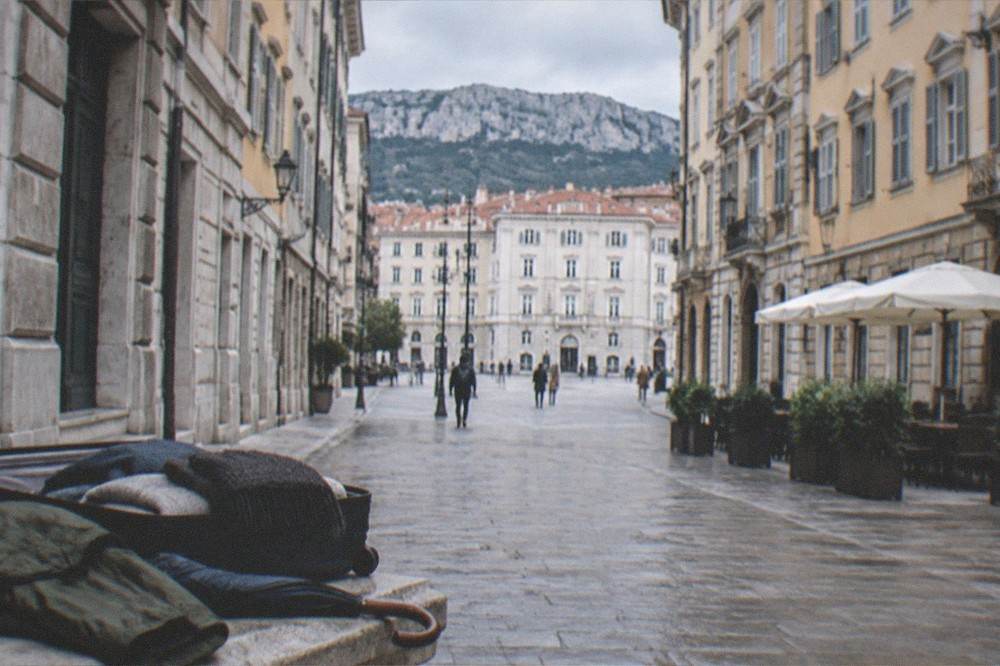
The weather rarely affects getting to Trieste, with one regular exception: strong bora episodes can disrupt the ferries and the maritime side of travel, so the practical rule is to check the live notices of the operator you are using the day before. Flights into Trieste Airport and trains into Trieste Centrale operate year-round on their normal schedules, and the city itself is compact enough that no weather short of a red-alert day stops it.
The route pages cover the details. For arrivals there are guides on flights to Trieste and the airport at Ronchi dei Legionari, and for rail the train station and rail connections guide. Cruise arrivals should read the cruise port guide. The one weather-specific point that matters for any of them: the airport sits inland from the coast and its disruption profile is ordinary aviation weather, while the port sits on the water and it is the port that carries the bora risk.
The border crossing question also has a weather-shaped edge, because the prettiest cross-border day trips, into Slovenia and down the Istrian coast, use the same coastal roads that the bora sweeps. There is no currency change and no routine passport control: Italy, Slovenia and Croatia are all in Schengen and all use the euro, and Croatia joined both on the same day, 1 January 2023. But Italy is running temporary border checks on its land border with Slovenia, an arrangement in force through 18 December 2026, so carry a passport or national ID card on any Slovenian day trip. The best month to visit Trieste question is the closest neighbour to this page, and the weather answer and the planning answer mostly agree.
Common Questions About Trieste Weather
What is the wettest month in Trieste?
November, at 109.8 mm of rain across 9.5 wet days on average, from the regional agency's station tables for the Trieste waterfront. September is second at 102.3 mm, and the two months anchor an autumn concentration of rain that is the real weather pattern of the city.
Is Trieste rainy in summer?
No. July is one of the driest months of the year at 53.8 mm, behind only January and March at 52.8 mm each, and June averages 62.5 mm. The city's rainy reputation comes from autumn, especially September and November, not from the summer season.
How hot does Trieste get in summer?
The mean daily high reaches 28.2 C in July and 28.1 C in August, with 18.8 days over 30 C in an average year, nearly all of them in those two months. Nights stay above 22 C on average. It is a warm, sea-modulated summer rather than an extreme one.
Does it snow in Trieste?
The station tables summarised here record temperature and precipitation totals rather than snow days, and no reliable snow-day figure for the city is published in them. Winters are mild, with a mean January low of 5.0 C and mean highs near 9 C, so snow is uncommon on the waterfront. The Carso plateau above the city is colder and sees more.
When is the sea warm enough to swim in Trieste?
June through September. The sea averages 23.1 C in June, 25.9 C in July and August, and 23.9 C in September, its warmest month relative to the air. October's average of 20.3 C is borderline, and from November the water is properly cold.
How windy is Trieste?
Very, by coastal Italian standards. The waterfront station averages 49.0 days a year with a gust over 72 km/h and 17.6 days over 90 km/h, and the monthly record gust exceeds 110 km/h in every month of the year. February is the windiest month and June the calmest.
What is the best month to visit Trieste for weather?
June for balance: summer warmth, modest rain at 62.5 mm, and the calmest wind of the year. September if a warm sea matters more than dryness, since the water peaks at 23.9 C while the air stays at a mean high of 23.9 C. July if heat and dryness are the goal.
When does the bora blow in Trieste?
Most persistently from November through March, peaking in February, though episodes are possible in every month. The wind blows from the east-north-east off the Carso plateau, and it can persist for days at a time. Check the live forecast rather than any published cutoff, because no official wind threshold for closures exists.
The short version of the whole page: pack for the wind, expect the rain in autumn not in summer, swim from June to September, and treat June and September as the two months that best balance everything Trieste's weather can throw at a visit.