Duino, Trieste Italy: Castles, Cliffs and the Rilke Trail
Duino is the cliff village west of Trieste in Italy, known for two castles, the poetry of Rainer Maria Rilke and one of the finest short coastal walks in Friuli Venezia Giulia.
Short answer
Duino is a small village in the Duino-Aurisina commune on the Adriatic coast just west of Trieste, Italy. It is known for two castles, the ruins and the residence, and for the Rilke Trail, a clifftop path that runs toward Trieste. The village sits where the Karst plateau drops into the sea.
Duino is a cliff village on the Adriatic coast immediately west of Trieste, in the Friuli Venezia Giulia region of Italy, and it packs more history per kilometre than almost anywhere else on this shoreline. Two castles stand above the water here, one a ruined medieval fortress and one a lived-in residence, and the clifftop path that starts at the village, the Sentiero Rilke, is one of the most walked short trails in the province. The poet Rainer Maria Rilke stayed in the newer castle before the First World War and began his Duino Elegies there, which is why the path, and half the signage in the village, carries his name. This page covers what Duino is, what you actually see when you get there, and how to plan the day.
What Is Duino and Why Do Visitors Come Here?
Duino is a village of a few hundred residents in the Duino-Aurisina commune, on the coast road west of Trieste, Italy, where the limestone plateau of the Karst falls into the northern Adriatic. Visitors come for three things: the two castles, the clifftop Rilke Trail toward Trieste, and the scenery where rock, woodland and sea meet. It is a half-day destination that pairs naturally with Trieste itself.
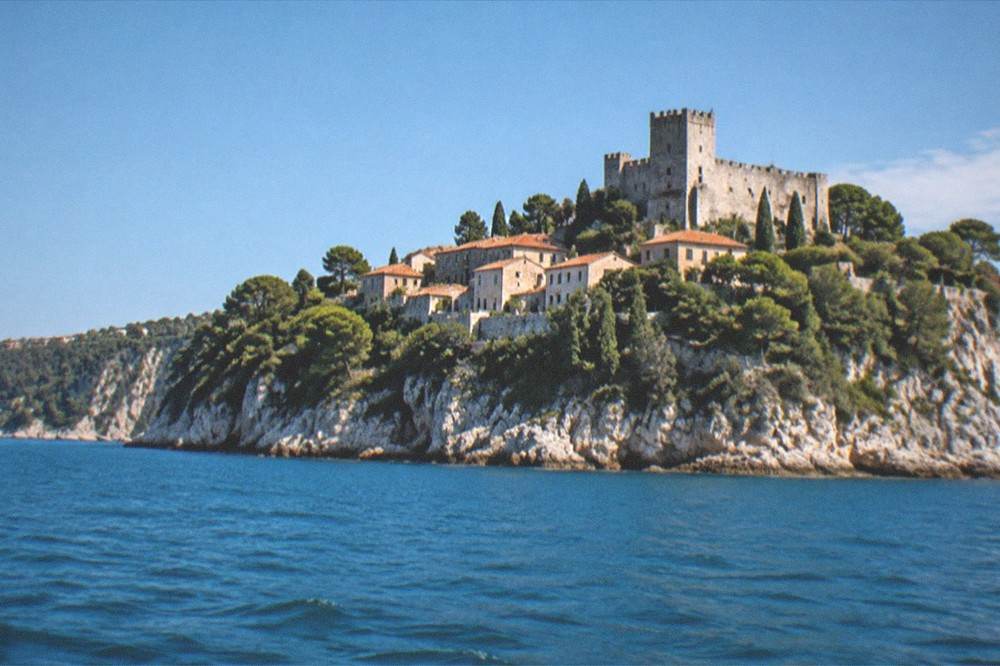
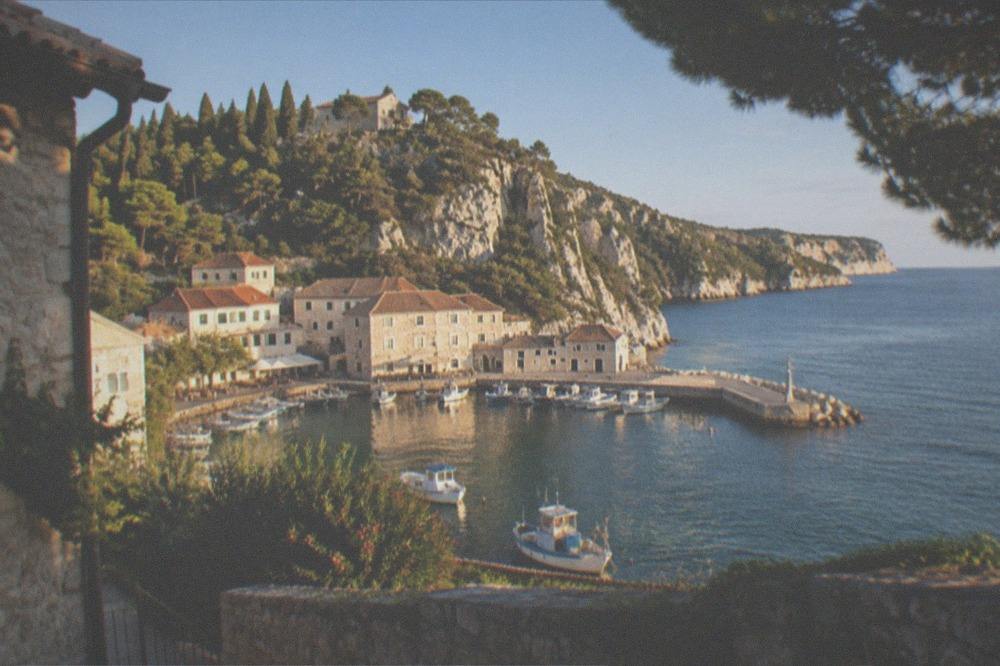
The village sits at the base of the cliffs, with a small marina, a seafront promenade and a cluster of houses that climb the slope. Above it, the castles. The older one is a ruin perched directly on the rock above the water, reachable on foot from the village, and the newer one, still a private residence owned by the same family that has held it for centuries, stands above the village with its own park. The full story of the fortress, its towers and its opening arrangements is on the Duino Castle attraction page.
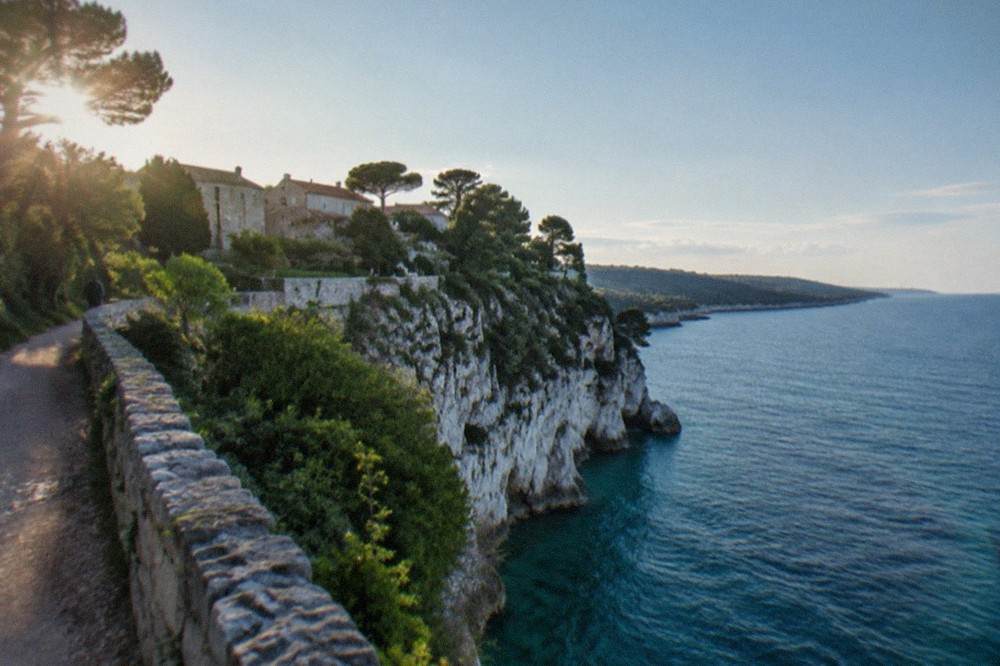
What makes Duino unusual on this coast is the abruptness of the landscape. Most of the shoreline between Trieste and Monfalcone is either city waterfront or flat beach, but at Duino the Karst plateau ends in vertical white rock, and the Sentiero Rilke threads along the top of it. The plateau behind the village is the same karst country described in detail on the Carso Karst plateau area page, with its sinkholes, dry stone walls and scattered villages.
What Are the Two Duino Castles?
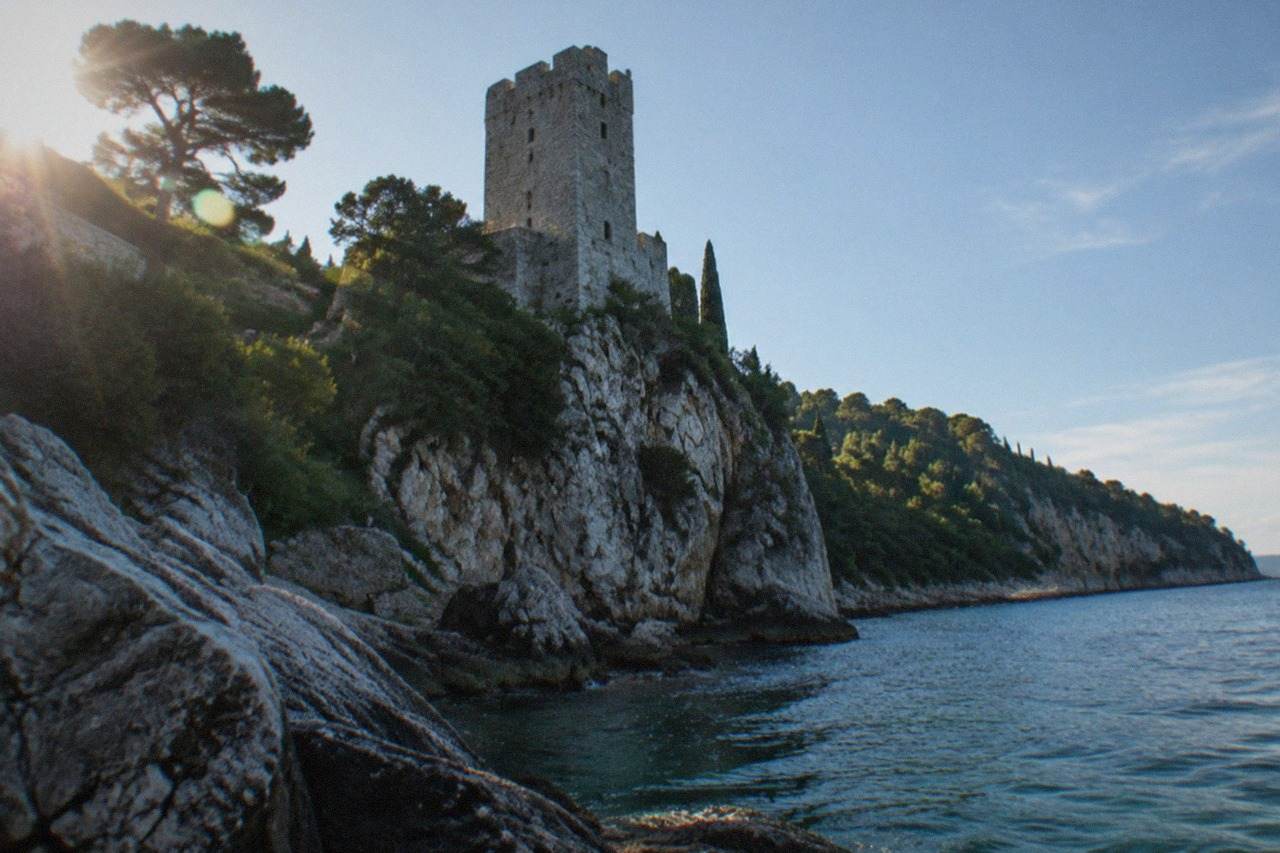
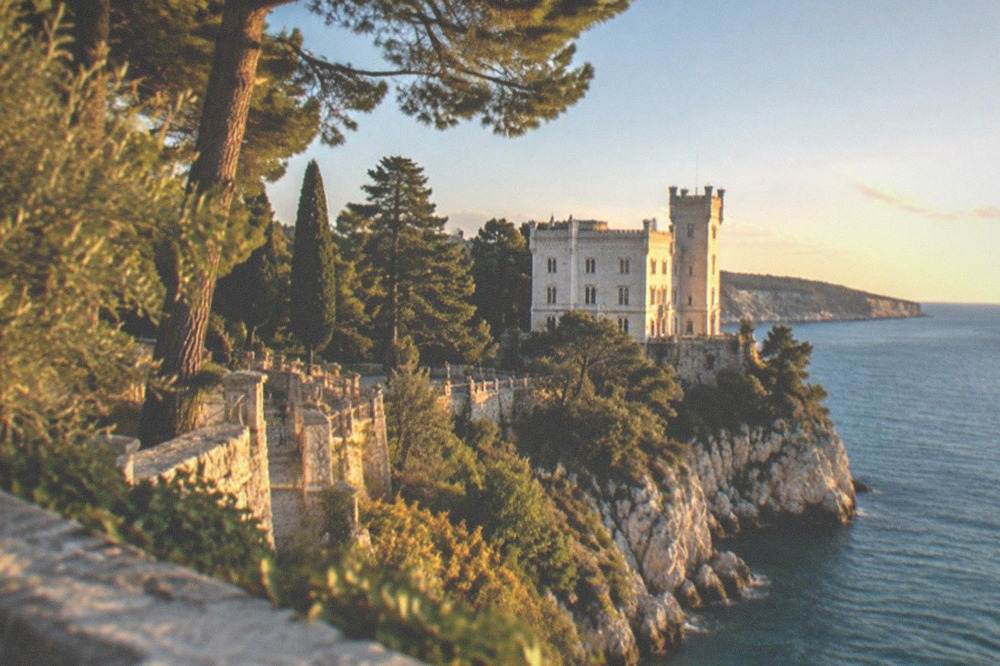
There are two castles at Duino: the Castello di Duino Vecchio, a ruined medieval fortress on a rock spur directly above the sea, and the Castello di Duino Nuovo, the newer residence above the village, which has been the seat of the Della Torre family, and before them the Thurn und Taxis family, since the sixteenth century. The ruin is walked around freely; the residence is the one with guided access, park and views.
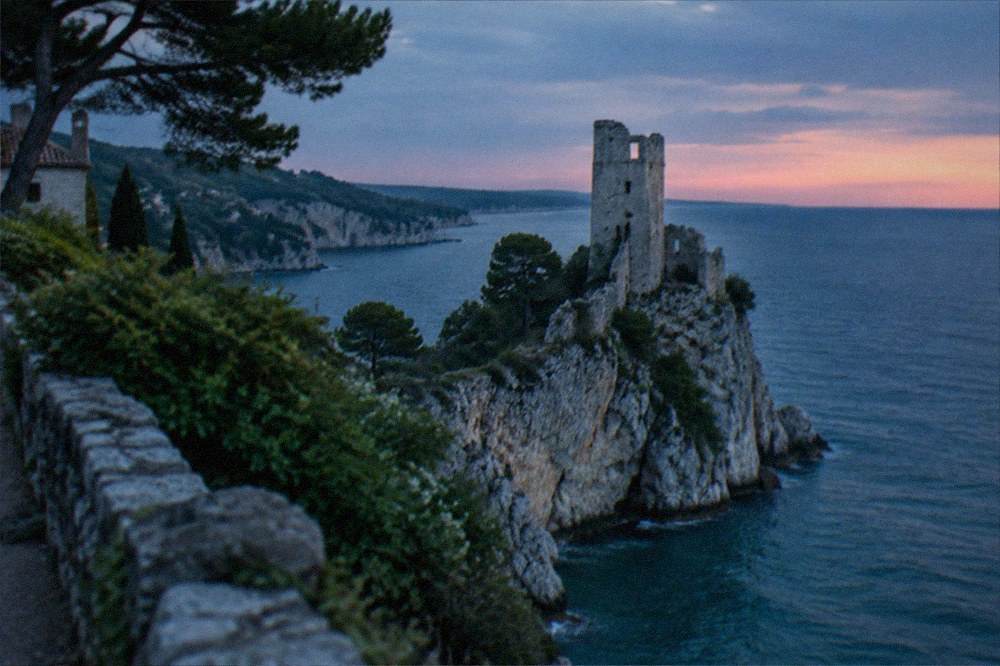
The old castle, the "Vecchio", is the one most visitors photograph first. Its walls and towers stand on a narrow spur of rock that juts toward the sea, and the position, rather than any single architectural feature, is the point: whoever held it controlled the entrance to the gulf. It was abandoned as a residence when the family moved up the hill, and what stands today is the shell of the fortress, open to the sky, with the drop to the water on three sides.
The new castle, the "Nuovo", is a working residence rather than a museum ruin, and that shapes how you visit it. The building itself is only partly accessible, and the visit is structured around the family's history, the park and the terraces. Rilke was a guest here, invited by Princess Maria von Thurn und Taxis, and the room associated with his stay is part of the castle's story. For opening days, ticket arrangements and everything practical, use the Duino Castle guide rather than secondhand summaries, because the residence's schedule changes with the season and with family use of the building.
A useful comparison for planning is how the castles around Trieste differ in kind, not just in price:
| Castle | Type | Access character | Adult ticket |
|---|---|---|---|
| Duino Vecchio (old) | Medieval ruin on the cliffs | Walked around freely, cliff site | Check the venue page |
| Duino Nuovo (new) | Lived-in residence with park | Structured visit, family seat | Check the venue page |
| Castello di Miramare | Museum and park | Full museum visit, audio app available | EUR 17.00, park free |
| Castello di San Giusto | City fortress and museums | Ticket covers walls, museums, lapidary | EUR 7.00, reduced EUR 5.00 |
Miramare, up the coast toward Trieste, is the natural comparison because it is the same kind of aristocratic coastal residence, built for an archduke, and it is fully open as a public museum. The Miramare Castle attraction page has the ticket detail, and the castle's own listing with an audio app is the easiest way to book:
What Is the Rilke Trail and Where Does It Start?
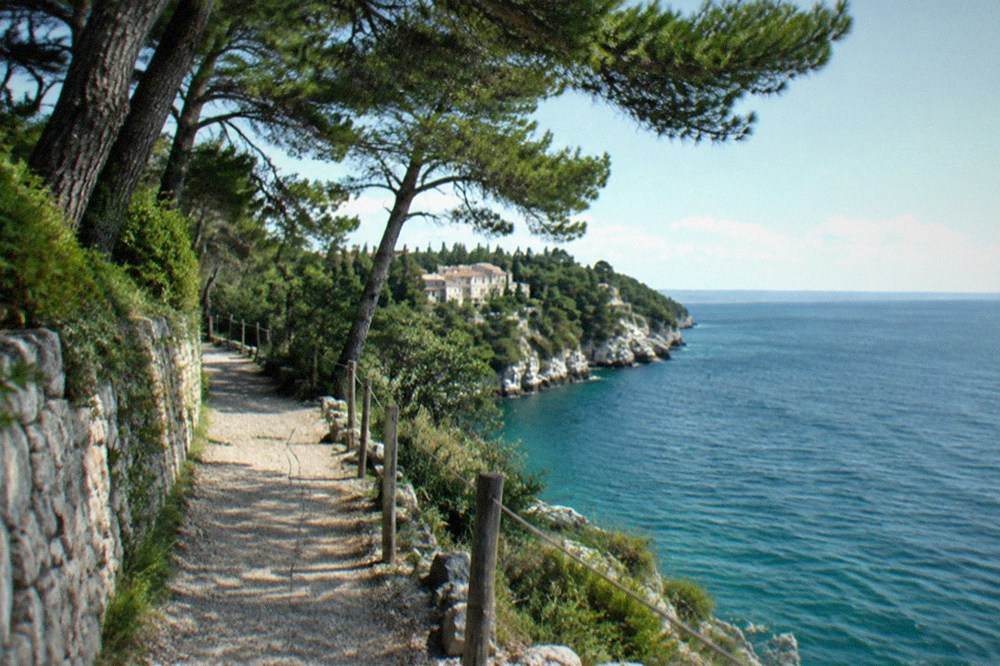
The Sentiero Rilke, the Rilke Trail, is a clifftop walking path between Duino and the suburb of Grignano near Trieste, following the edge of the Karst above the Adriatic. It starts within a short walk of Duino's seafront, climbs past the old castle and runs westward along the cliffs, with the sea below the whole way. It is named for Rainer Maria Rilke, who walked this coast while staying at the castle.
The trail is the single best reason many Trieste residents give for going to Duino at all. It is not a mountain hike: it is a coastal path, sometimes stepped, sometimes on gravel, always with the drop to the water somewhere in view. The direction most people walk it is from Duino toward Grignano, which puts the sea on your right and ends you near Miramare's park and the marine protected area around it, described on the Miramare marine protected area page.
The full practical route, including where to start, what the path surface is like and how to combine it with a castle visit, is laid out step by step on the Trieste to Duino and the Rilke Trail day trip page. That page is the one to plan from, because it treats the walk as the spine of the day rather than an afterthought.
Rilke himself is the reason the path carries the name. He was a guest of the Thurn und Taxis family at the new castle in the winters before the First World War, and the poems that became the Duino Elegies began there, in a place where the cliffs, the wind and the water are all present at once. The trail is not a literary museum, but the landscape you are walking through is the one the poems came out of, and the connection is why the route is waymarked and maintained.
What you pass on the trail, in the order most walkers meet it:
| Point on the trail | What it is | Why it matters |
|---|---|---|
| Duino seafront and marina | Start of the walk, village base | Parking, food, the flat beginning |
| Old castle spur | Ruin on the rock above the sea | The classic Duino view and photo |
| Cliff sections | White karst rock above water | The trail's signature scenery |
| Woodland stretches | Pine and karst scrub on the plateau | Shade in the middle hours |
| Grignano end | Suburb with a marina near Miramare | Finish, food, castle next door |
What Can You See from the Duino Cliffs and the Coast?
From the clifftops at Duino you see the northern Adriatic shoreline running east toward Trieste, the Gulf of Trieste, the plain toward Monfalcone and, on clear days, the coastline of Slovenia beyond the gulf. Below the cliffs the water is clear and the rock drops steeply, which is why this stretch, rather than the city beaches, is where people come to look rather than to lie on sand.
The view east is the one that orients you. Trieste's own seafront is visible from the higher ground, and the city's great square sits at the head of that waterfront. Looking west, the coast runs toward Sistiana and its bay. On a clear day the horizon carries the far shore of the gulf.
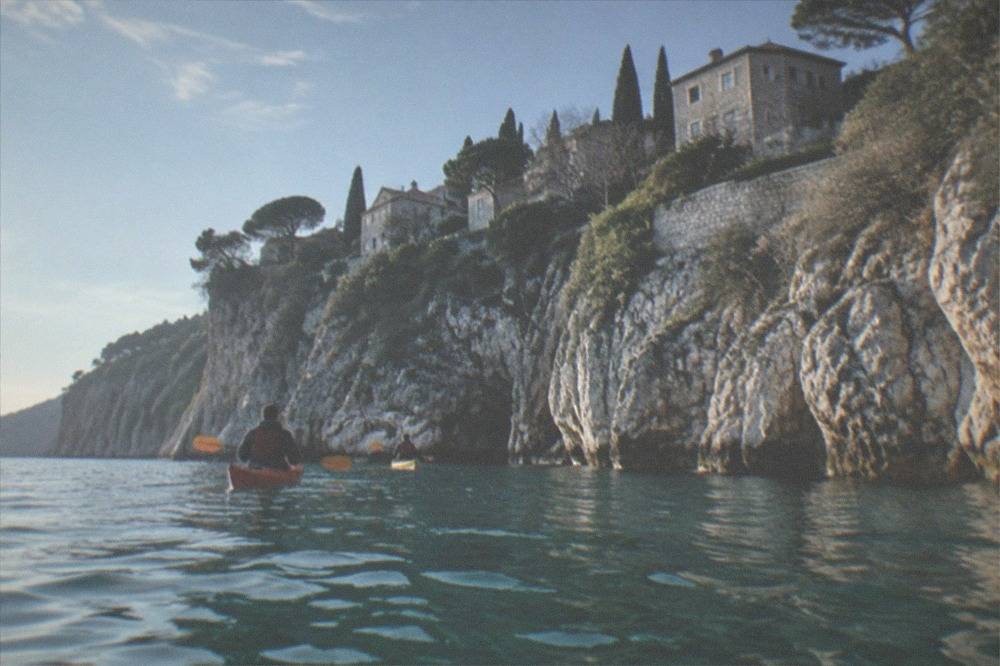
The water itself deserves attention. The coast around Duino and Grignano sits inside the protected marine area off Miramare, where the karst rock continues underwater and the sea stays unusually clear for the northern Adriatic. Kayak tours run along this stretch, paddling beneath the Duino Castles from the water side, and that is a genuinely different way to see the cliffs: from below rather than above. One such trip, a three-hour guided paddle along this coast, is listed with the operator's live listing:
The rocks and cliffs are also why this coast, and the plateau behind it, are caving country. The same limestone that makes the cliffs makes the caves, and the biggest show cave in the area, with a guided descent and its own museum entry, is described on the Grotta Gigante page and sits inland in the same Duino-Aurisina commune. A cave visit and a coast walk usefully do not compete for the same hours of the day.
Who Lived at Duino Castle and Why Does Rilke Matter So Much?
Duino's literary fame rests on Rainer Maria Rilke, the Prague-born poet who stayed at the new castle as a guest of Princess Maria von Thurn und Taxis before the First World War and there began the Duino Elegies, the cycle many critics consider his greatest work. The castle family itself, the Thurn und Taxis and later the Della Torre della Torre di Valsassina, gave the village its shape.
The princess was Rilke's patron and correspondent, and their letters are a record of the place. The poet arrived in a period of creative paralysis, and the poems that broke it, opening with a cry he said he heard in the wind off the cliffs, are named for the castle itself. Very few villages in Italy have a major poem cycle named after them, and that is Duino's odd distinction.
The family history is the other thread. The Thurn und Taxis were a princely postal dynasty who held the estate for centuries, and the current owners, the Della Torre family, descend in the female line and still live there. A castle that is a home behaves differently from a castle that is a museum: opening hours bend around the family, rooms close without ceremony, and the visit is a guest's visit. That is the honest framing, and the Duino Castle attraction page carries the current practical detail.
If the literary angle is what is drawing you to the area, it is worth knowing that Trieste's own writing history runs deep as well. The city's most famous resident writer is James Joyce, and the Jewish heritage walk, which threads the city's literary and mercantile past together, is one of the more distinctive guided tours operating out of Trieste:
How Do You Get to Duino from Trieste?
Duino is reached from Trieste by the coast road heading west, by local bus services on that road, and by bike or car; the Rilke Trail then connects Duino on foot toward Grignano and Miramare. There is no rail station at Duino itself, and the trail and the coast road are the two fixed reference points for planning. Check the operator's route planner for current bus timetables rather than relying on older summaries.
The honest planning advice is simple. The coast road is the artery, the bus runs along it, and the trail is the car-free alternative for the Duino to Grignano leg. For anything time-specific, a departure frequency, a fare, a season schedule, the operator's own planner is the only source that is not already out of date, and this site does not print figures the operators have not published in a checkable form.
If you are building the day from Trieste itself, the standard pattern is in the one day in Trieste itinerary: city morning, coast afternoon. Duino slots into the afternoon half, with the trail as the activity and the castle as the anchor. Two-day travellers have more slack, and the two days in Trieste itinerary shows where a coast half-day fits.
One thing worth knowing before you go, because it affects the whole region's logistics: the Opicina tram, Trieste's famous hill tramway, was reactivated on 1 February 2025 and runs today from piazza Dalmazia, its current city terminus, on the published line 2 timetable. Older guides still describe it as suspended, and that is wrong. If your day involves the plateau rather than the coast, the tram is the distinctive way up.
Where Should You Combine with Duino in One Day?
The natural pairing with Duino is Miramare Castle and its park at Grignano, because the Rilke Trail ends there and the two castles make one coherent story of coast aristocracy. The second pairing is Sistiana, west along the coast, for the bay and the beach side of the same shoreline. With more time, the karst interior behind Duino, the caves and the plateau villages, fills a second day easily.
Grignano and Miramare are the obvious combination and the one most itineraries use. You walk the trail one way, end at the castle park, which is free all year, and visit the castle itself, which is EUR 17.00 for an adult with the temporary exhibition included, or EUR 7.00 reduced for EU citizens aged 18 to 25 with the exhibition, or EUR 2.00 for the castle only at that age. The castle is open every day 9:00 to 19:00 with last admission at 18:30. Those are the venue's own published figures, and the Miramare Castle page restates them in full.
The full day-trip structure, trail logistics, timing and food stops, is on the Trieste to Duino and the Rilke Trail day trip page. If you would rather have the coast day organized end to end, the panoramic city and Miramare tour, a four-hour guided outing that includes the castle, covers this same shore:
How the pieces fit together:
| Combination | What it adds | Best for |
|---|---|---|
| Duino plus Miramare | Second castle, park, marine area | First-time visitors, half a day |
| Duino plus Sistiana | Bay, beach, coast road scenery | A full coastal day |
| Duino plus karst interior | Caves, plateau villages, wine country | A second day, a car day |
| Duino plus Trieste city | Squares, Città Vecchia, caffè | The classic first trip |
The karst interior deserves its own mention because it is the landscape Duino's cliffs are the edge of. The wine country of the Carso, with its Vitovska and Malvasia and Terrano rather than Prosecco, is close enough that a tasting fits an afternoon, and the origins-of-Prosecco experience from the roster runs in exactly that karst country around the village of Prosecco itself:
What Does a Day in Duino Cost?
A day in Duino costs very little at the core: the village, the old castle spur and the Rilke Trail are walked freely, and the marina seafront costs nothing. The variable items are the new castle visit, food, and any transport. For comparison, Miramare Castle is EUR 17.00 for an adult, San Giusto in Trieste is EUR 7.00, Grotta Gigante is EUR 15.00 guided only, and Museo Revoltella is EUR 8.00.
The honest budget picture is that Duino itself is nearly free and the add-ons are what you pay for. The trail is free, the village is free, the old castle ruin is walked around freely. If you add the new castle, check the venue page for the current ticket and tour arrangement, because the residence's pricing follows its own schedule rather than a standard tariff. If you add Miramare, the figures above are the verified ones, and the park alone is free all year.
Here is what the region's headline paid entries look like side by side, all from the venues' own published rates:
| Venue | Adult ticket | Notes |
|---|---|---|
| Castello di Miramare | EUR 17.00 | Includes temporary exhibition; park free all year |
| Castello di San Giusto | EUR 7.00 | Covers walls, museums, lapidary; reduced EUR 5.00 |
| Grotta Gigante | EUR 15.00 | Guided tours only, booking compulsory |
| Museo Revoltella | EUR 8.00 | Reduced EUR 6.00, closed Tuesdays |
| Risiera di San Sabba | Free | National monument, no booking for individuals |
| Duino old castle spur | Free to walk around | Ruin on the cliffs above the village |
Two things to keep straight about the free entries, because guides get them wrong. The Risiera di San Sabba, Trieste's national monument, is free to enter, and the cathedral of San Giusto is free to enter, with the bell tower price unpublished and not to be guessed. And the ministry's first-Sunday-of-the-month free-entry scheme exists and Miramare takes part in it, but the details have changed more than once, so check the venue's own event page for the month rather than trusting a standing rule.
When Is the Best Time of Year for the Duino Coast?
The best months for the Duino coast are late spring through early autumn, roughly May to September, when the sea is at its warmest and the cliff path is dry and fully open. November is the wettest month at Trieste's waterfront station, at 109.8 mm of rain on average, and July is one of the driest, at 53.8 mm, so summer is not the rainy season here despite the latitude.
The climate data for this coast comes from the regional agency's own station tables at Trieste molo Fratelli Bandiera, and it tells a story that contradicts the "rainy Adriatic" assumption. The wettest stretch is autumn: November at 109.8 mm and September at 102.3 mm. Midsummer is comparatively dry. For a walking-and-cliffs day, that matters more than the sea temperature does.
| Month | Mean high C | Rain mm | Character for the coast day |
|---|---|---|---|
| May | 21.7 | 75.0 | Green, light, good walking |
| June | 25.8 | 62.5 | Warm, sea warming fast |
| July | 28.2 | 53.8 | Driest stretch, busiest |
| August | 28.1 | 71.7 | Peak sea warmth, 25.9 C mean |
| September | 23.9 | 102.3 | Warm sea, wetter skies |
| October | 19.6 | 88.6 | Barcolana month, windier |
| November | 14.7 | 109.8 | Wettest month, quiet paths |
One regional quirk worth planning around: the bora, the east-north-east wind that funnels down the gulf, blows hardest in the cool season, and the station tables show an average of 17.6 days a year with a gust over 90 km/h, with the monthly record gust exceeding 110 km/h in every single month of the year. There is no published official wind threshold at which the coast closes or ferries stop, so do not believe any number a guide gives you for that; check the forecast and the operators directly. The wind is part of the coast's character, and Rilke heard it before anyone wrote it down.
Common Questions About Duino Near Trieste
Is Duino worth visiting from Trieste?
Yes. Duino gives you two castles, a famous clifftop walk and some of the clearest water on this coast, all in a village you can cover in half a day. It is the standard half-day escape from the city and the natural end point of the coast road heading west.
Can you walk from Duino to Miramare?
Yes, the Rilke Trail runs from Duino along the cliffs toward Grignano, the suburb beside Miramare's park, and the trail is the car-free way to make that leg. Plan the direction and the practical details from the Trieste to Duino and the Rilke Trail day trip page, which treats the walk as the spine of the day.
Is Duino Castle the same as Miramare Castle?
No. Duino Castle is the residence above the village of Duino, held by the Thurn und Taxis family and now the Della Torre family, with a ruined older fortress beside it on the cliffs. Miramare is the archduke's castle at Grignano, fully open as a public museum at EUR 17.00 for an adult, with the park free all year.
Who wrote the Duino Elegies?
Rainer Maria Rilke, the Prague-born poet, began the Duino Elegies while a guest at Duino Castle before the First World War, invited by Princess Maria von Thurn und Taxis. The cycle is named for the castle, and the clifftop path from the village carries his name for the same reason.
How much does Duino cost to visit?
The village, the seafront and the old castle spur cost nothing to walk around, and the Rilke Trail is free. The new castle visit follows the residence's own schedule, so check the venue page. Miramare, the common add-on, is EUR 17.00 for an adult, EUR 7.00 reduced for EU citizens 18 to 25 with the exhibition.
Does it rain a lot in Duino?
The wettest month on this coast is November, averaging 109.8 mm at the Trieste waterfront station, with September second at 102.3 mm. July averages just 53.8 mm and is one of the driest months, so summer visits are not the gamble the latitude suggests.
The last practical note is the one that ties the whole coast together. Duino, Grignano, Miramare and Sistiana are one continuous shoreline, stitched by the trail and the coast road, and the mistake visitors make is treating them as separate trips. Walk the trail, see the castles, swim if the season allows, and let the village be the anchor it has been for four centuries. More area guides, including Barcola and the city's old core, sit alongside this one across Trieste Travel Guide.