Do People Swim in Trieste?
Do people swim in Trieste, Italy? Yes: locals swim at Barcola, at the Pedocin and off the Carso coast, in a sea that ARPA's own bulletins show reaching 25.9 C in August. Here is where, when and how.
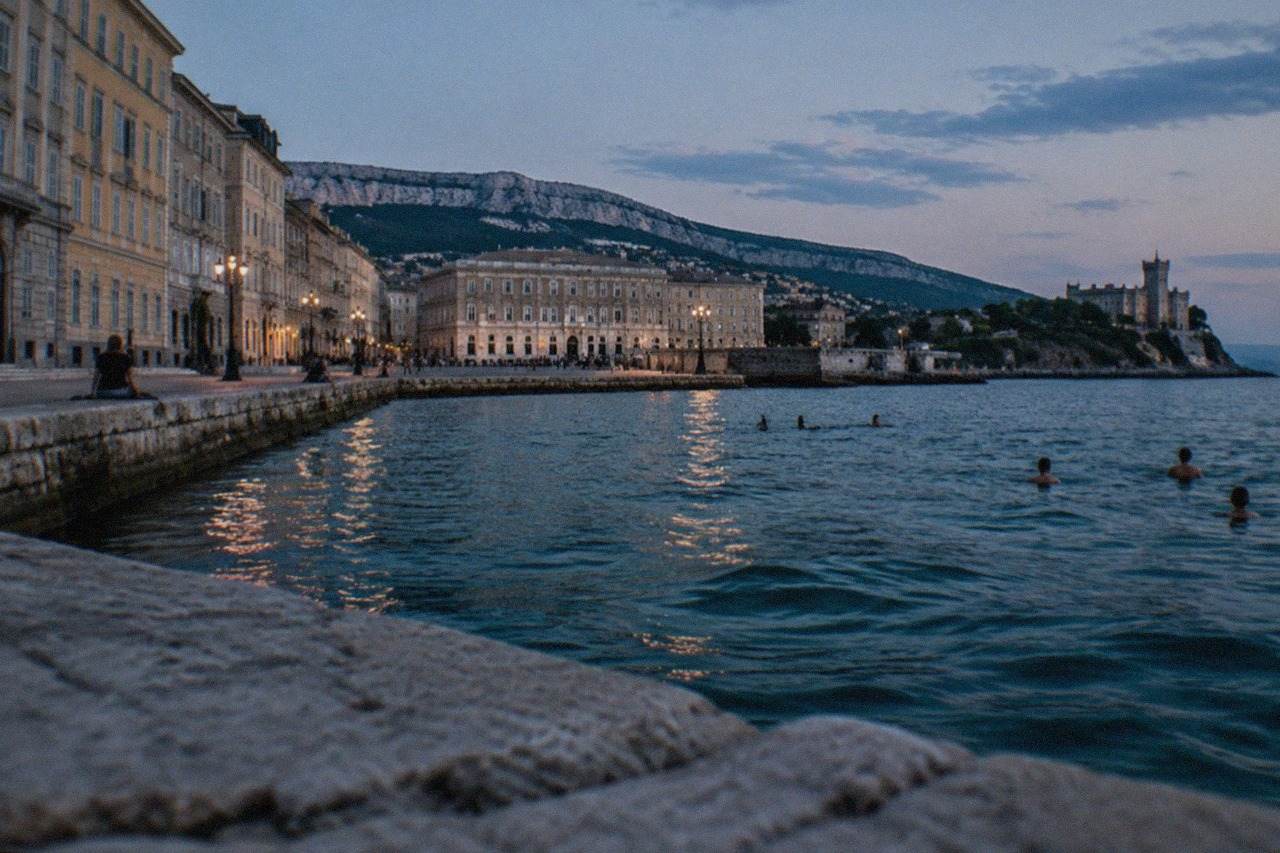
Trieste, Italy, faces the Adriatic from a crescent of stone quays and a seafront the whole city leans against, and the question people ask before visiting is whether anyone actually gets in the water. The answer is unambiguous: swimming is a normal, daily part of life here, from the concrete piers of Barcola to the historic bathing establishment at the Lanterna. The city's own seafront, the Rive and the gulf beyond are not scenery; they are where a substantial share of Trieste's population spends its summer mornings before work, in a ritual that the tourist boards of the region document and that ARPA FVG, the regional environment agency, tracks in monthly sea-temperature bulletins.
Do People Swim in Trieste?
Yes, people swim in Trieste, and they do it with a commitment that startles visitors. Locals swim at the Barcola seafront, at the Bagno Marino Lanterna, known as the Pedocin, and off the rocky coast of the Carso, and many swim year-round, not only in summer. The gulf's water reaches a monthly mean of 25.9 C in both July and August, and ARPA FVG's oceanographic bulletins show swimmable conditions generally running from June into early October.
The swimming culture here is tied to the shape of the city. There is no long sandy beach in the centre; Trieste's waterfront is stone, concrete and rock, and the city built its bathing life around that. The Barcola seafront, a short ride up the coast, is the classic answer: a paved promenade with steps and platforms straight into deep water, busy from early morning with swimmers doing lengths parallel to the shore. The Pedocin, the historic bathing establishment at the Lanterna below the city centre, is the other pole, a walled pool of sea with separate sections, one of the last of its kind on this coast.
What surprises people is the season. The sea in the Gulf of Trieste warms late and stays warm late. ARPA's monitoring at the molo Fratelli Bandiera station, running continuously since 1996, shows the annual pattern clearly: cold winter minima, rapid warming through spring, and August peaks, with September often warmer than June even at similar air temperatures, because the water holds the summer's heat. That thermal lag is the reason local swimmers treat September as a swimming month rather than the start of autumn.
Where Do Locals Actually Swim in Trieste?
Locals swim at three kinds of place: the Barcola seafront with its free steps and platforms, the Bagno Marino Lanterna, the Pedocin, Trieste's historic walled sea-bath by the lighthouse, and the rocky coves and platforms along the coast toward Grignano and the Carso. All are sea swimming, there is no freshwater swimming in the city itself, and all sit within the Gulf of Trieste that ARPA FVG monitors continuously.
Barcola is the volume answer. The seafront promenade doubles as a linear swimming pool: locals enter from the rocks and the built steps, swim along the line of the shore and dry off on the concrete. The promenade fills with the full cross-section of the city, from lane-swimmers in caps to families with small children in the shallower entries. Our guide to the Barcola seafront covers the layout, and the deeper local picture, including the swimming clubs and the winter bathers, is in where locals go swimming in Trieste.
The Pedocin is the historic answer, and the one with a story. The Bagno Marino La Lanterna is a walled bathing complex fed directly by the sea, sitting below the Victory Lighthouse at the edge of the city centre, and it preserves a separated layout that dates from another era of seaside manners. It is the place where the city's swimming tradition is most visible as an institution rather than a habit. The details, including how the sections work, are in our Bagno Marino Lanterna and Pedocin guide.
Beyond the city, the coast changes character. Toward Grignano and the Miramare marine protected area the shore turns to rock and pine, with entries from platforms and coves rather than promenades, and the Carso plateau beyond drops cliffs into unusually deep, clear water. The full range, including the beaches people drive to, is in our Trieste beaches and swimming guide.
When Is the Sea Warm Enough to Swim in Trieste?
The Gulf of Trieste reaches its warmest monthly means of 25.9 C in July and August, with June at 23.1 C and September at 23.9 C, so the core swimming season runs June to September, and September is often warmer than June because the sea retains summer heat. May, at a mean of 17.9 C, is for the hardened, and by October the mean drops to 20.3 C.
Those figures come from a different source than the land climate numbers on this page: the sea temperatures are ocean reanalysis data from the Copernicus Climate Change Service, delivered via a marine data API, while the air and wind figures are from ARPA FVG's own station tables. The two sources agree on the shape of the story, which is a gulf that warms fast in late spring, peaks in August and cools slowly. Everything else covered here is indexed on Trieste Travel Guide.
| Month | Mean sea temperature | Mean air temperature | Rain mm |
|---|---|---|---|
| May | 17.9 C | 18.8 C | 75.0 |
| June | 23.1 C | 23.1 C | 62.5 |
| July | 25.9 C | 25.2 C | 53.8 |
| August | 25.9 C | 25.2 C | 71.7 |
| September | 23.9 C | 21.2 C | 102.3 |
| October | 20.3 C | 17.1 C | 88.6 |
Two things in that table run against visitor expectations. The first is the rain: July is the second-driest month of the year at the molo station at 53.8 mm, behind January and March at 52.8 mm, and the wet months here are autumn ones, November first at 109.8 mm and September second at 102.3 mm. Anyone postponing a Trieste swimming trip for fear of a rainy Italian summer has the calendar backwards. The second is September itself: the sea at 23.9 C is warmer than June's 23.1 C even though the air has cooled by two degrees, which is the thermal inertia ARPA's bulletins describe and the reason the locals keep swimming well past the schools going back.
Does the Bora Wind Stop People Swimming in Trieste?
The bora, Trieste's cold north-easterly, does blow hard through the gulf, with the station record showing a peak gust of 168.1 km/h in February 2012 and gusts over 110 km/h recorded in every month of the year, but it does not stop the swimming season. June is the calmest month, averaging 0.3 days with a gust over 90 km/h, and July averages 0.9, fewer than November's 1.9.
The wind is the fact about Trieste that every guide repeats, and it is real: ARPA's station tables for the molo Fratelli Bandiera, covering 1995 to 2024, average 49.0 days a year with a gust over 72 km/h and 17.6 days over 90 km/h, and the monthly record gust exceeds 110 km/h even in midsummer. But the distribution matters more than the headline. The strong-bora season is the cool one, November to March, peaking in February, and the summer months are the quietest of the year for wind, not the wildest.
| Month | Days gust over 72 km/h | Days gust over 90 km/h | Record gust km/h |
|---|---|---|---|
| June | 2.2 | 0.3 | 110 |
| July | 3.3 | 0.9 | 125 |
| August | 2.9 | 0.9 | 124 |
| September | 3.5 | 1.1 | 124 |
| November | 5.2 | 1.9 | 147 |
No official authority publishes a wind speed at which the seafront closes or swimming becomes prohibited; no such threshold was found on any official source, so none is stated here. What the wind does do is shape where swimming happens on a given day: a strong bora flattens some parts of the gulf and whips others, and local swimmers simply pick the sheltered side. The full anatomy of the wind, including why it funnels the way it does, is in our guide to the bora wind, and the month-by-month picture for planning is in the best time to visit Trieste.
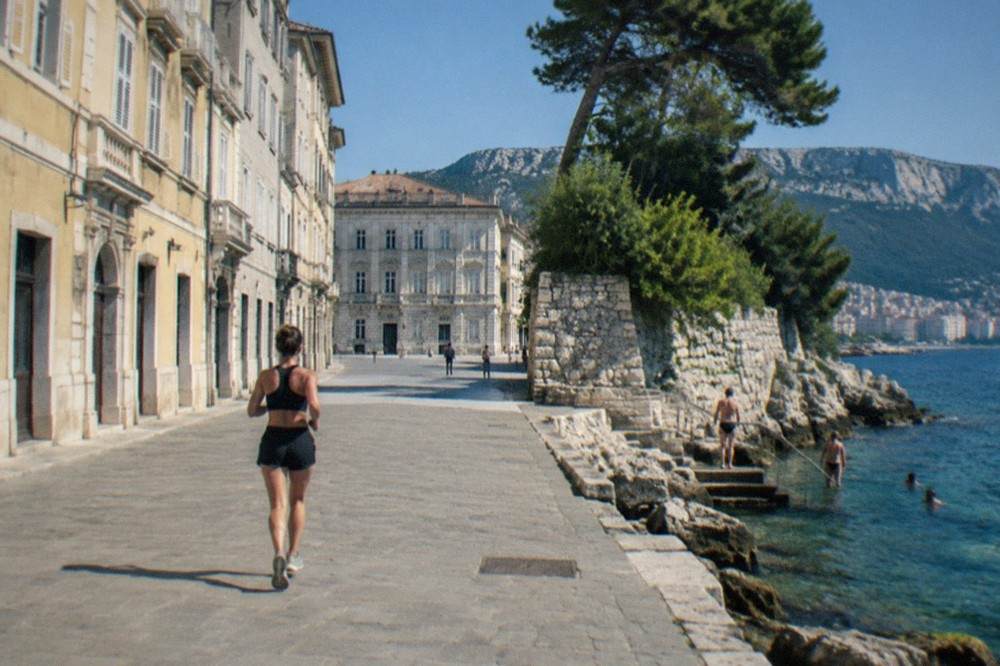
Can You Swim Outside Trieste on a Day Trip?
Yes, and the coast on both sides of the Italian border is built for it. Slovenia's Adriatic shore, reachable from Trieste on tours such as a 6-hour Piran and Slovenia coast trip from $114.64, offers swimming towns on the same gulf, and Croatia's Istrian coast lies a short hop further, with Croatia in both the euro area and Schengen since 1 January 2023. Carry a passport or ID card: Italy is running temporary border checks with Slovenia through 18 December 2026.
The nearest swimming outside the city is not even another country's business: the coast at Sistiana and Duino, up the gulf from Trieste, is the same stretch of water the locals claim as their own. The most direct way to see it from the water itself is the Trieste Kayak Adventure along the Duino coast, a 3-hour guided paddle beneath the Duino castles, rated 4.88 from 11 reviews and priced from $76.81 per person on the operator's live listing. Check availability
Across the border, Slovenia's short coastline packs Piran, Portorož and Koper into a few kilometres of shore, all on the same gulf and the same sea temperatures. A 6-hour Piran and Slovenia coast tour from Trieste runs from $114.64 per person, rated 4.57 from 136 reviews, and pairs the panoramic coast road with free time in Piran itself. Croatia is the second hop: Rovinj and Pula sit on Istria's western shore, and the practicalities of reaching them, including the ferry question, are covered in our answer to is there a ferry from Trieste to Croatia.
The border detail matters more here than anywhere else in the region. Croatia adopted the euro and joined Schengen on the same day, 1 January 2023, so there is no currency to change and no routine passport line on paper, but Italy is running temporary internal border checks on its land border with Slovenia, currently listed by the European Commission's register through 18 December 2026. A passport or national ID card is the sensible thing to have in a pocket on any coastal day trip from Trieste, and the checks are temporary and dated, not a permanent feature of the border.
Common Questions About Swimming in Trieste
Do people swim in trieste?
Yes. Trieste, Italy, has an everyday swimming culture centred on the Barcola seafront, the Pedocin bathing complex at the Lanterna and the rocky Carso coast, with a season that runs from June into early October and a hardened year-round minority.
How warm is the sea in Trieste?
The Gulf of Trieste averages 25.9 C in July and August, 23.1 C in June and 23.9 C in September, per ocean reanalysis data for the gulf. ARPA FVG's own bulletins, measured at the molo Fratelli Bandiera since 1996, show swimmable conditions generally from June to September or early October.
Does it rain all summer in Trieste?
No. July is the second-driest month of the year at the city's waterfront station, at 53.8 mm, and the wettest months are November, 109.8 mm, and September, 102.3 mm. Trieste's rain problem is an autumn one.
Is there a beach in the centre of Trieste?
Not a sandy one. The city swims from stone and concrete: the steps and platforms of the Barcola promenade, the walled sea-pool of the Pedocin, and rock entries along the coast toward Grignano and the Carso.
Does the bora wind make swimming impossible?
No official threshold exists for closing the seafront, and none is published by any authority. The strong-bora season is November to March; June is the calmest month, averaging 0.3 days a year with a gust over 90 km/h.
Can you swim in Slovenia or Croatia on a day trip from Trieste?
Yes. Slovenia's coast at Piran and Portorož is on the same gulf, and Croatia's Istrian coast is a short hop further. All three countries use the euro, and Croatia joined Schengen on 1 January 2023, but Italy is running temporary border checks with Slovenia through 18 December 2026, so carry a passport or ID card.
The short version is that swimming in Trieste is not a visitor activity that the city tolerates; it is a civic habit with infrastructure, a measured sea and a season that lasts longer than most people's summer holidays do. Plan around the autumn rain rather than a summer wind, and the gulf is yours.