Jota, Goulash and the Trieste Buffet: Trieste Italy's Hearty Table
Trieste, Italy, eats like nowhere else in the country: sauerkraut soup, paprika goulash and buffet counters that trace their trade to the Habsburg port.
Short answer
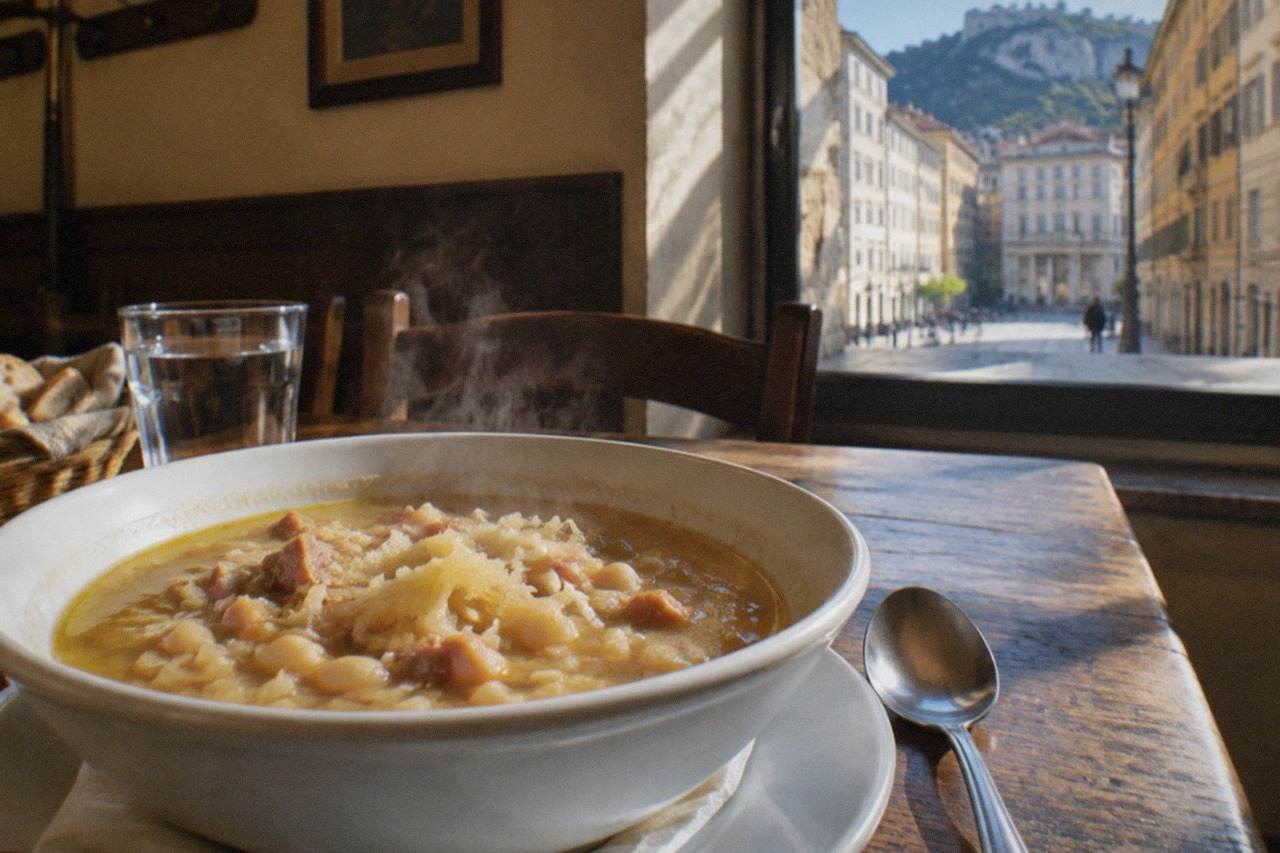
Jota is Trieste's signature soup of sauerkraut, beans and pork, served in the city's historic buffets alongside goulash and other Central European dishes.
Trieste, the Adriatic port city in Friuli Venezia Giulia in the northeast corner of Italy, keeps a table that puzzles first-time visitors expecting pasta and pizza. The city's signature dish is jota, a soup of sauerkraut, beans and pork, and its native eating house is the buffet, a counter serving hot stews that has more in common with Vienna than with Naples. This guide explains what jota is, where the tradition came from, what else waits on the buffet counter, and how to eat your way through it today.
What Is Jota Soup?
Jota is a thick, sour soup built on sauerkraut, dried or canned beans, potatoes and pork, seasoned with garlic and bay and, in many Trieste kitchens, a spoonful of flour browned in lard. It is the single most characteristic dish of Trieste, Italy, eaten across the city and the surrounding Carso plateau in cold weather, and it exists nowhere else in the Italian canon in this form.
The sourness is the point. Fermented cabbage, locally called crauti or capuzzi, gives the soup an acidity that no other Italian region builds a soup around. The beans, usually borlotti, soften it; the pork, often a smoked hock or a rind, deepens it. Some versions finish with a dusting of cumin. The result is closer to a Central European one-pot meal than to anything served further down the Italian coast, which is exactly the story of the city itself.
Every Triestine family argues about the correct version, and the arguments are part of the dish. Some insist the beans must be dried and soaked overnight, never canned; others hold that the cabbage must be rinsed only once so the sourness survives the long simmer. There are kitchens that add a whole potato to be mashed into the broth at the end, and kitchens that would consider that a scandal. What no one disputes is that jota is a meal, not a starter: a bowl with bread and a glass of red wine is a complete lunch, and it was eaten as one by dockworkers, sailors and port clerks for as long as the city has been a port. For the wider picture of the local table, see our guide to what to eat in Trieste.
Where Does Jota Come From?
Jota comes from the Central European kitchen that Trieste absorbed during its centuries as the Habsburg empire's main port, with roots shared across the Friuli countryside, the Slovenian Karst and the wider Alpine-Adriatic world. The word itself is traced to a regional term for the soup, and the dish belongs as much to the Slovene-speaking villages around Trieste as to the city's Italian-speaking kitchens.
Trieste grew rich as the sea gate of Austria, and its food carries the empire's fingerprints. Sauerkraut, goulash, pork shank, strudel and the buffet counter all arrived with the administrators, sailors and merchants who passed through the port. The city sits on the Slovenian border, and the countryside behind it, the Carso, is bilingual to this day, so the cooking never separated cleanly into "Italian" and "Slovene". Jota is the clearest case: the same soup appears on both sides of the border with local accents.
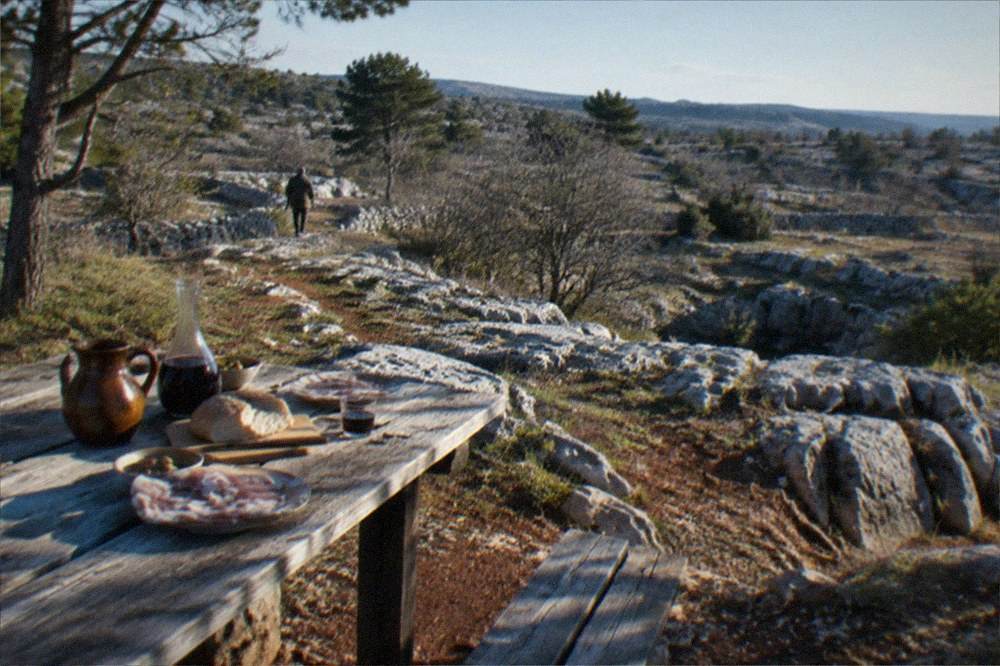
The preservation logic behind the dish is older than any empire. Winters on the Adriatic plateau are cold and the wind is brutal, so farm kitchens fermented cabbage in autumn, dried beans on the vine and salted pork at slaughter time, and jota is what those stores became when they went into one pot. The soup is, in that sense, a farm recipe that the port adopted. The political history behind that border is covered in a short history of Trieste, and the hillside farmhouses that sell their own wine and produce, the osmize, have their own guide at osmize of the Carso.
| Element | Role in the dish | Notes |
|---|---|---|
| Sauerkraut (crauti) | The sour backbone | Fermented white cabbage, drained and rinsed |
| Beans | Body and sweetness | Usually borlotti, dried or canned |
| Pork | Depth and salt | Smoked hock, rind or cubes of pancetta |
| Potato | Thickening | Diced, cooked into the broth |
| Browned flour (pistùm) | Traditional finish | Flour toasted in lard, stirred in at the end |
| Cumin and bay | Seasoning | Cumin is common but not universal |
What Is a Trieste Buffet?
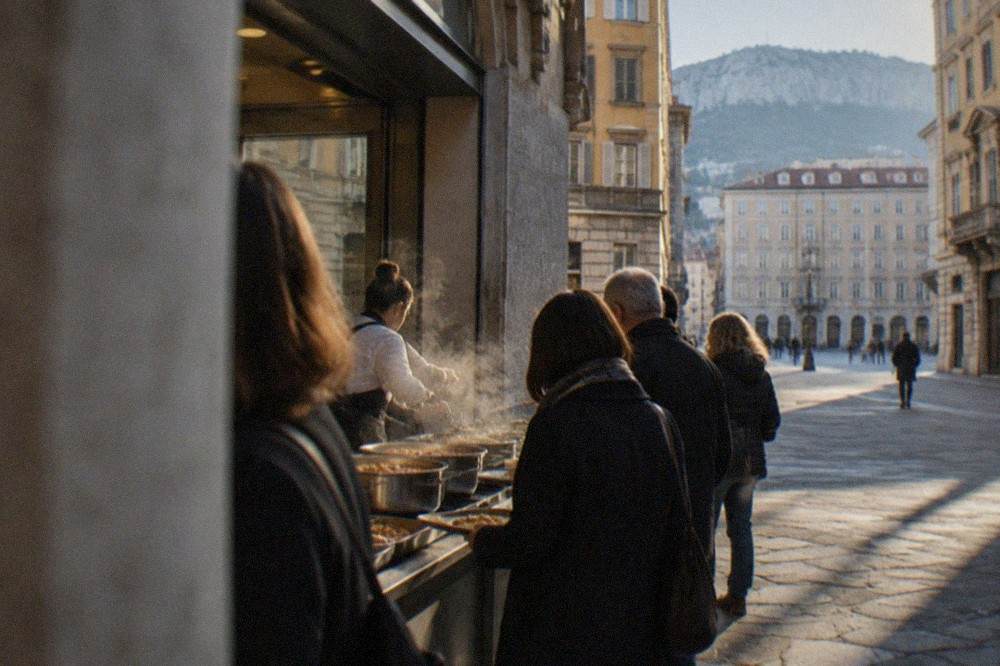
A buffet in Trieste is a small, old-style eating house serving hot cooked dishes over a counter, from mid-morning through the afternoon, in the tradition of the Habsburg-era Beisl. It is not a hotel breakfast spread and not an all-you-can-eat: you order at the counter, take a stool or a small table, and eat goulash, jota, pork shank and sausages washed down with local wine or beer.
The buffet is a working institution. Regulars come for a plate at lunch, a mid-afternoon break or an early supper, and the counter is the point: you see what is in the pots before you choose. The dishes are slow, wintry and cheap relative to a sit-down restaurant, and the atmosphere is closer to a tavern than to a ristorante. Goulash, paprika-seasoned beef stew served with bread or potato, is the other headline dish, and pork shank, muset with brovada, cotechino-style sausages and stuffed cabbage all rotate through the pots.
The counters keep their own etiquette, and it rewards a first-timer to know it. You pay at the till first in many of them, or settle up when you leave; you do not wait to be seated; and the standing tables by the wall are not a lesser option but the traditional one, used by workers on a short break since the port's busiest days. Wine comes by the decilitre, poured from the bottle into a small glass, and a "rosso" or a "bianco" is answer enough if the list is long. Nobody will hurry you, but the rhythm is quick, and the pots are at their best before the afternoon lull empties the room. The tradition is so central to the city that a guided walk is one of the most reliable ways in: the Trieste Guided Foodie Walking Tour runs three hours through the city centre, from $71.08 per person, rated 4.9 from 264 reviews on the operator's live listing, and it is built around exactly these counters. Check availability
If you would rather build your own route, the counters cluster in the old lanes and around the market streets, and a first visit rewards going at lunch when every pot is full. Either way, plan at least one meal of the trip around a buffet, because it is the one eating experience in Trieste that exists nowhere else in Italy in this form.
What Dishes Go with Jota and Goulash?
The classic Trieste buffet spread is goulash, jota, muset with brovada, salsicce, stuffed cabbage rolls and pork shank, followed by strudel or presnitz, with a glass of Terrano or Vitovska from the Carso. Bread is served with everything, mustard and cren, grated horseradish, stand on the counter, and the meal rarely costs what a restaurant dinner does.
Muset is a cotechino-style boiled pork sausage, and brovada is turnips soured in grape marc, another echo of the preservation kitchen this climate demanded. Salsicce are the local pork sausages, and capuzzi, braised sour cabbage with sausage, is effectively jota's dry cousin. The sweet finish is Central European too: strudel and presnitz, a spiral pastry of dried fruit and nuts, both crossed the border with the empire. The wine that belongs with all of it is the Carso's own: Terrano, a red grown in the red earth of the plateau, and Vitovska, the region's white. The full picture is in Friuli Venezia Giulia wine.
Cren deserves its own sentence, because it surprises people. Grated fresh horseradish, sharp enough to clear the sinuses, is the standard partner to the boiled and roasted pork dishes, the way mustard is elsewhere, and a buffet table will have a bowl of it beside the salt. If you have never eaten horseradish with sausage, the combination is one of the small discoveries of eating in this city. The other surprise is how little of the menu is fried: this is a stew-and-boil kitchen, and the closest thing to fast food is a plate of cevapcici, grilled minced meat rolls that arrived from the Balkan side of the port's trade. The wider set of guides lives on Trieste Travel Guide.
| Dish | What it is | Where the tradition points |
|---|---|---|
| Jota | Sour cabbage, bean and pork soup | Friuli and the Karst, on both sides of the border |
| Goulash | Paprika beef stew | Hungary via the Habsburg empire |
| Muset con brovada | Boiled pork sausage with soured turnips | Friuli farm kitchen |
| Capuzzi | Braised sour cabbage, often with sausage | Trieste and the Carso |
| Salsicce | Local pork sausages, boiled or grilled | The port's pork trade |
| Strudel and presnitz | Pastry of apple, or dried fruit and nuts | Austria, via Vienna's port |
Where Should You Eat Jota in Trieste?
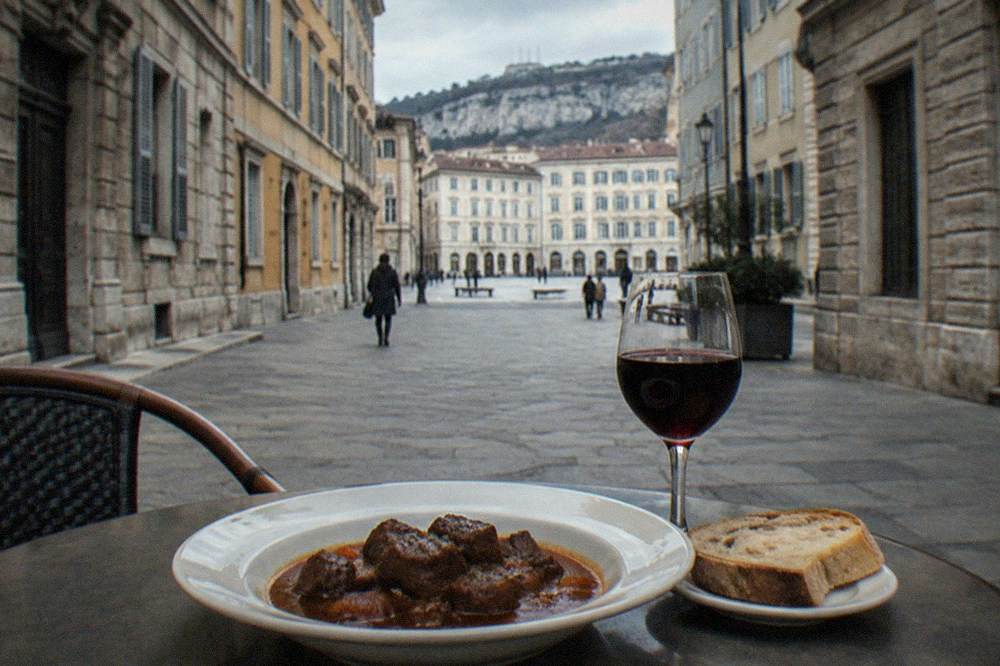
The honest answer is the historic buffets of the city centre and the Città Vecchia, the old town behind Piazza Unità d'Italia, plus the osmize on the Carso in season, where farmhouse kitchens serve their own wine and simple hot plates. Names change and hours shift, so the reliable move is a food walk with a local guide on your first day, then return to the counters you liked.
A first visit rewards a plan. The buffets cluster in the old lanes and around the market streets, and they fill at lunch. The osmize are different: they open only in limited windows, signposted by a frasca, a leafy branch hung at the turning, and the volunteer-run calendar at osmize.com lists who is open on which day. Our best restaurants in Trieste guide covers the sit-down side of the city, and the free, tip-based Discover Trieste walking tour on GuruWalk, run by a local guru, is a zero-cost way to get oriented before you commit to a table.
Can You Learn to Cook Jota Yourself?
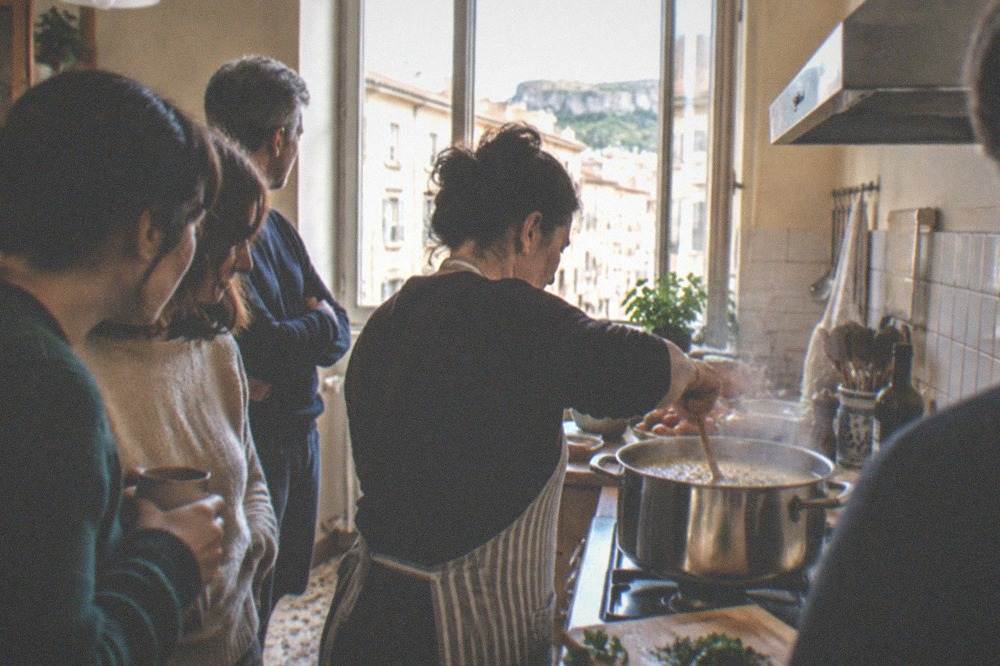
Yes, and Trieste is one of the easier Italian cities to do it in: private cooking classes in local homes run around three hours and teach the city's home repertoire, and a guided foodie walk covers the tasting side. The private home class on the roster costs from $166.23 per person, lasts three hours and is rated 3.9 from 6 reviews on the operator's live listing, so read recent reviews before booking.
Cooking jota is not technically hard, it is a peasant one-pot, but the details matter: rinsing the sauerkraut to the right sourness, the browned flour finish, the long simmer that pulls the pork into the beans. A local cook shows you the texture cues that a recipe cannot. For a group alternative, a small-group pasta and tiramisù class from $157.65 per person, rated 4.4 from 40 reviews, teaches the Italian classics rather than the buffet repertoire, so choose the home class if jota is the goal.
| Experience | From | Rating | Length | Focus |
|---|---|---|---|---|
| Trieste: Guided Foodie Walking Tour | $71.08 per person | 4.9 from 264 reviews | 3 hours | Street food and buffet counters |
| Trieste: Unique Food Tour with Local Flavors and Tastings | $85.98 per person | 4.7 from 123 reviews | 3 hours | Walking food tour of the centre |
| Trieste: Unique Food Tour, premium listing | $87.58 per person | 4.9 from 88 reviews | 3 hours | Mediterranean and Central European mix |
| Trieste: Private Cooking Class at a Local's Home | $166.23 per person | 3.9 from 6 reviews | 3 hours | Home cooking, hands-on |
| Trieste: Small Group Pasta and Tiramisù Class | $157.65 per person | 4.4 from 40 reviews | 3 hours | Italian classics |
When Is Jota Season?
Jota is a cold-weather dish, and Trieste's own climate tables say why: ARPA's waterfront station records a January mean low of 5 C and a November mean of 12.5 C, with November the wettest month of the year at 109.8 mm of rain. Locals eat the sour, heavy pots from late autumn through early spring, and the buffet counters thin their winter repertoire out in summer, when the city's eating moves toward the seafront.
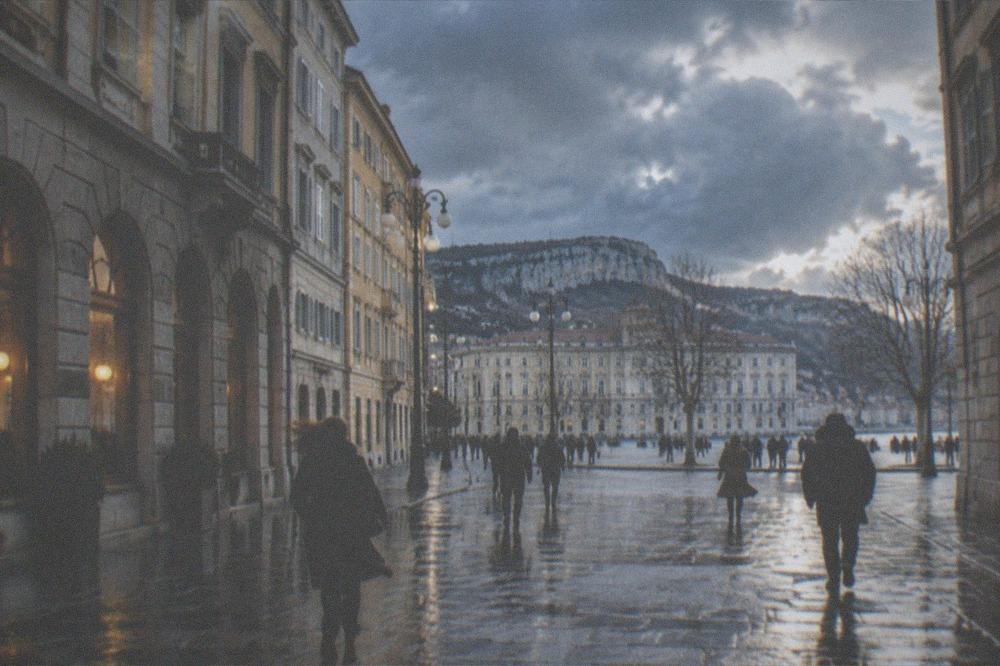
The bora, the cold north-easterly wind that funnels down the Adriatic, sets the rhythm of the winter table. ARPA's station tables for Trieste molo Fratelli Bandiera record an average of 17.6 days a year with a gust over 90 km/h, with the peak gust in the series at 168.1 km/h in February 2012, and the windy season runs November through March. A day of bora is a day for jota. In summer, July is the second driest month at 53.8 mm and the mean high reaches 28.2 C, and the appetite shifts to swimming off the seafront and lighter plates. The wind has its own guide at the bora wind, and month-by-month figures are in Trieste weather month by month.
| Month | Mean low C | Rain mm | The buffet table |
|---|---|---|---|
| November | 10.3 | 109.8 | Full winter pots, jota and goulash daily |
| December | 6.4 | 77.4 | Peak buffet season, Christmas market in the squares |
| January | 5 | 52.8 | Coldest month, the sour soups at their best |
| February | 5.2 | 59.7 | Windiest month, bora days and hot stews |
| July | 22.4 | 53.8 | Lighter plates, the seafront takes over |
How Does Jota Change Across the Region?
Jota is not only Trieste's: versions run across Friuli Venezia Giulia and into Slovenia, with the Friulian countryside favouring a thicker, more potato-heavy bowl, the Karst villages keeping the pork-and-cabbage balance, and some kitchens using brovada, soured turnip, in place of cabbage entirely. The one constant is the sour note, and the dish marks the whole Alpine-Adriatic borderland rather than one city.
That spread is a map of the city's identity. Trieste has been Italian only since the twentieth century, and its food never pretended otherwise: the buffet counter, the sauerkraut and the paprika are the edible record of centuries as Vienna's port. The same logic explains the caffè culture, which arrived with the same administrators and stays central to daily life; it has its own guide at Trieste coffee culture. The Historic Cafés Experience, a three-hour coffee-culture walk from $74.52 per person, rated 4.9 from 19 reviews, pairs naturally with a buffet lunch for a full day of the city's two great edible institutions.
What Should a First-Time Visitor Actually Order?
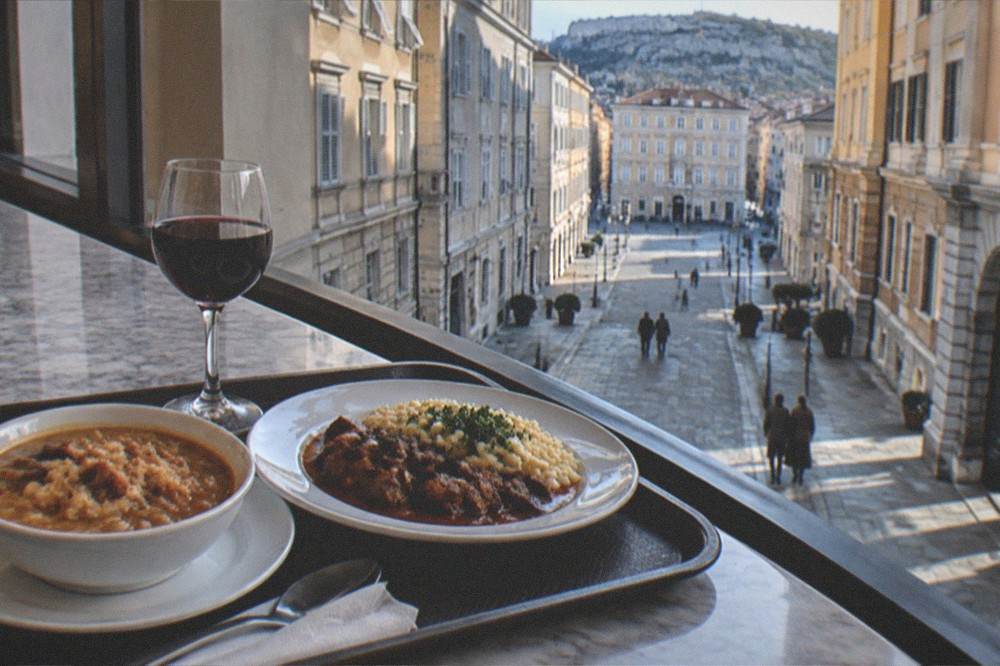
Order jota first, goulash second, and muset con brovada third if the counter has it, with bread, a glass of Terrano and a presnitz to finish. If you only have one meal in the city, make it lunch at a buffet in the old town, because the counters are at their fullest then, and follow the locals standing at the bar rather than sitting for a long service.
For a one-meal visitor, timing matters more than the specific address. Counters run from mid-morning and the pots are at their best before the afternoon lull. If your visit is short, the foodie walking tour above compresses the tasting into three hours and is the cheapest way to cover the buffet repertoire with someone who can explain each pot. If you have longer, the free things to do in Trieste guide stretches a budget around the eating, and why Trieste is famous explains what else the city is known for beyond the table.
One last piece of planning advice: pair the meal with the rest of the day. The buffets sit inside a compact, walkable centre, so a morning at the castle or the seafront, a long buffet lunch and an afternoon caffè stop is a genuinely Triestine shape for a day, and it needs no car and no timetable. Eat the way the city eats, slowly and in the wrong country's tradition, and you will have understood the place better than most visitors do.
Common Questions About Jota Soup and the Trieste Buffet
What is jota soup?
Jota is Trieste's signature soup: sauerkraut, beans, potato and pork simmered together, often finished with flour browned in lard and seasoned with cumin and bay. It is a sour, heavy, cold-weather dish rooted in the Habsburg and Friulian farm kitchen rather than the Mediterranean one.
What is a buffet in Trieste?
A Trieste buffet is a small counter eating house serving hot cooked dishes, goulash, jota, sausages and pork, from mid-morning through the afternoon. It is a tavern-style institution inherited from the city's Habsburg era, not a hotel breakfast or an all-you-can-eat.
Is jota Italian or Slovenian?
Both, and neither exclusively. The same soup is eaten in Trieste, across the Friulian countryside and in the Slovene-speaking villages of the Karst, with local variations. Trieste's food has been Central European since its centuries as Austria's port, and jota is the clearest example of a dish that ignores the border.
When do people eat jota in Trieste?
From late autumn through early spring. The city's climate tables show a January mean low of 5 C and November as the wettest month, and the bora wind season peaks in the cold months, all of which points the appetite at sour, slow-cooked pots rather than summer plates.
Can you take a food tour of Trieste's buffets?
Yes. The Trieste Guided Foodie Walking Tour runs three hours from $71.08 per person, rated 4.9 from 264 reviews on the operator's live listing, and covers the city's street food and counters with a local guide. Check availability on the listing for current dates and times.
What wine goes with jota and goulash?
The Carso's own red, Terrano, is the traditional pour, with Vitovska, the plateau's white, as the alternative. Both are grown in the red earth behind the city and are covered in our Friuli Venezia Giulia wine guide.
Trieste eats the way its history made it, and jota is the proof in the bowl: an Italian city that never gave up its sour cabbage, its paprika or its counter lunch.